
Contact us
- Chongqing Industrial Design Promotion Center
- No. 1, Shangqingsi Road, Yuzhong District, Chongqing, People's Republic of China
- +86-23-60332626
- [email protected]

Editor’s Note
This year’s CCTV Spring Festival Gala featured a robot-themed skit that vividly depicted future life scenarios, inspiring widespread longing. And the future shown on screen is gradually becoming reality.
Space information, low-altitude economy, embodied intelligence… In 2024, Chongqing took the lead nationally in laying out future industries and formulating an action plan for their cultivation. A large number of future industry projects have taken root and grown in the mountain city, moving from laboratories into people’s lives.
Starting today, the “Touching the Future in Chongqing” series will take you into laboratories, industrial parks, and application scenarios, using images and words to help you feel the future.
Industry category: Advanced new materials.
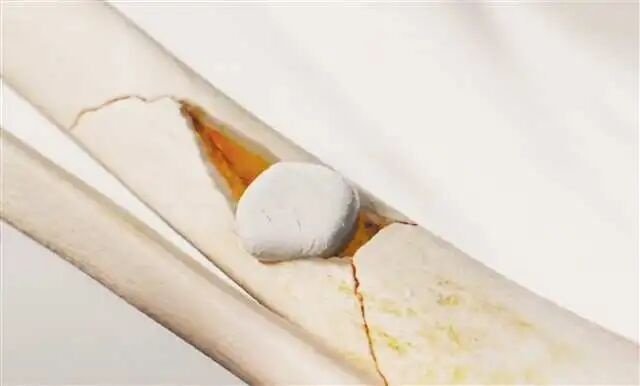
Features: Can be freely shaped by hand; after implantation, it guides bone growth; once new bone forms, it disappears.
Application scenarios: Comminuted fractures, bone loss due to tumor resection, bone tissue destruction from osteomyelitis, residual voids after bone tissue removal; future applications also include dental fillings, medical aesthetics, and more.
A patient with a comminuted fracture is wheeled into the operating room.
Conventionally, a metal prosthesis would be used to replace the damaged bone. Instead, the surgeon takes out a white solid and places it in warm water.
Within minutes, the solid softens, becoming like Play-Doh. The doctor shapes it into the desired form, applies it like glue to the broken bone fragments, then reduces and fixes them. Months later, new bone has grown, but the “Play-Doh” has vanished.
This is not a scene from a science fiction film, but a glimpse into a future medical scenario.
This “Play-Doh” is called “Nüwa Stone”, a new type of bone repair material jointly developed by the Biomaterials Research and Innovation Center of the National University of Singapore (NUS) Chongqing Research Institute and Chongqing Lixing Biomaterials Technology Co., Ltd. In January this year, the material received a Class III medical device registration certificate from China’s National Medical Products Administration (NMPA). It is the world’s first bone repair material that can be instantly shaped during surgery, remains intact in water, induces autologous bone regeneration, and fully degrades.
The birth of “Nüwa Stone” can be traced back to a laboratory mistake eight years ago.
In 2018, Dr. Sun Yang, a materials science Ph.D. from the National University of Singapore, returned to China to start a business, leading a team focused on high-end medical devices.
One day in May of that year, an operator was conducting a routine experiment, attempting to synthesize a new composite material from hydroxyapatite (the main inorganic component of human bone) and polylactic acid (a biodegradable polymer) for a 3D printing project in collaboration with a hospital.
According to protocol, all reagents in this experiment had to be purified. But that day, he forgot to treat one of them.
When the experiment ended, the expected white powder did not appear. Instead, a sticky, white, Play-Doh-like substance sat at the bottom of the beaker, too viscous to pass through the 3D printer’s nozzle.
“Waste,” the operator glanced at it, labeled it, and tossed it into a corner of the warehouse.
The wonder of science often hides in overlooked corners.
Months later, when the team was clearing out inventory, they casually threw this “waste” into water to test its stability—expecting it to dissolve. The next day, it remained intact; a week later, still the same.
At the time, the team was fully focused on its 3D printing project, so this “anomaly” was merely noted in the lab log and not pursued further.
The real turning point came nine months later.
In January 2019, Sun Yang attended a biomedical engineering forum. During a break, an orthopedic expert from Shanghai Sixth People’s Hospital mentioned a clinical pain point: during arthroscopic minimally invasive surgeries, materials used to fill bone defects must be manipulated while immersed in blood and tissue fluid. Existing materials were either too hard to shape on the spot or disintegrated in water, making procedures highly risky.
“Is there a material that can be shaped like Play-Doh in water and yet maintain its integrity?”
Hearing this, Sun Yang’s heart skipped a beat—didn’t that “waste” in the warehouse fit the description?
He rushed back to the lab that night, retrieved the sample, and conducted systematic tests: after 72 hours of soaking, its form remained stable and its performance uncompromised. The sample was quickly sent to Shanghai. After the orthopedic expert verified it in a simulated surgical environment, he exclaimed with delight: “This is it!”
A chance discovery often leads to an inevitable destination. The path there, however, was a five-year uphill battle.
Why did the “Play-Doh” not dissolve in water? What exactly was triggered by that “forgotten purification” step?
Sun Yang immersed himself in the lab, investigating variables and reconstructing the process to replicate that mistake. But three months passed, and dozens of attempts all failed: the material either disintegrated in water or hardened like stone, never achieving that perfect “Play-Doh” consistency.
The root of the problem lay in the inherent conflict between the two materials: hydroxyapatite, like stone, readily absorbs water; polylactic acid, like plastic, is naturally hydrophobic. They repel each other like oil and water.
A new breakthrough came in April 2019.
After reviewing hundreds of research papers and drawing on over a decade of theoretical accumulation, the team proposed an entirely new technical route—molecular interface engineering. This involves precisely controlling the interaction between the two materials at the nanoscale, allowing them to “shake hands” on their own.
“Figuratively speaking, it’s like building a nanoscale bridge between two islands that don’t connect,” Sun Yang explained. The earlier operational mistake had inadvertently stumbled upon the optimal conditions for them to “join hands.”
Following this approach, the team adjusted parameters hundreds of times. Finally, that perfect “Play-Doh” reappeared at the bottom of the beaker.
What followed was an even longer process of refinement—temperatures had to be controlled within ±2°C, cooling rates adjusted in stages… The team spent five years, iterating over 20 product versions, ultimately securing multiple core patents, obtaining FDA certification, and building China’s first production line for medical-grade nanocomposite bone repair materials.
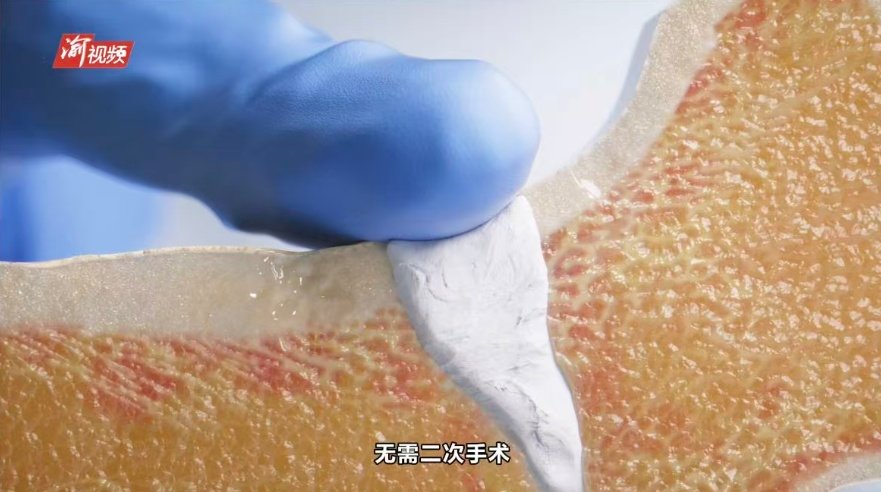
▲Bone repair material “Nüwa Stone”. Video screenshot
What truly amazes is the actual performance of “Nüwa Stone” on the operating table.
In early 2025, a female patient in Malaysia suffered a comminuted fracture of the radial head, a critical part of her elbow joint.
“It was too shattered to put back in place. Standard treatment would require a metal prosthesis to replace the damaged bone. But a metal prosthesis has a lifespan of only about 10 years, meaning the patient would need another surgery a decade later,” Sun Yang said.
In a critical moment, the lead surgeon took out some “Nüwa Stone” that Sun Yang had previously sent and made a bold attempt: first, the bone fragments were meticulously repositioned, then “Nüwa Stone” was used like a “biological glue” to adhere and fix the fragments together, and finally two bone screws were inserted to reattach the joint.
The outcome exceeded all expectations. Three months after surgery, new bone had successfully grown. After the screws were removed, only the patient’s own healed bone remained in the joint, avoiding a second surgery.
“The surgeon called me later; his voice was trembling with excitement,” Sun Yang recalled.
That same year, Guo Lin, director of the Sports Medicine Center at Southwest Hospital, used “Nüwa Stone” clinically for the first time.
The case involved a patient with a knee cartilage defect that was too large to be adequately filled with existing materials. During surgery, Guo Lin rolled “Nüwa Stone” into strips, packed them into the cartilage defect, and smoothed the surface, achieving a seamless fit.
Three months later, a follow-up exam showed new bone had grown. The material had completely vanished.
“It’s like a perfect repair. This is the ideal material orthopedic surgeons have been waiting for years,” Guo Lin marveled. “High-intensity activities like running and jumping often cause cartilage defects in the knee and ankle joints. Patients urgently need a material like this. At my sports medicine center alone, we perform nearly 200 such procedures annually.”
Guo Lin is now actively promoting the routine use of “Nüwa Stone” at Southwest Hospital. He estimates that Chongqing sees 2,000 to 3,000 relevant cases per year.
What delights Sun Yang even more is that clinicians have developed additional innovative uses for this “Play-Doh.”
Postoperative infection is a major concern in orthopedic surgery. Doctors have wrapped antibiotic powder inside “Nüwa Stone” like dumpling filling. After implantation, as the material gradually degrades, the antibiotics are precisely released, achieving localized drug delivery. This technique has completed preliminary R&D and is about to enter clinical trials. Furthermore, the material can be applied to other subfields, such as dentistry and aesthetic filling.
In the future, more and more patients will benefit from this “Play-Doh.”
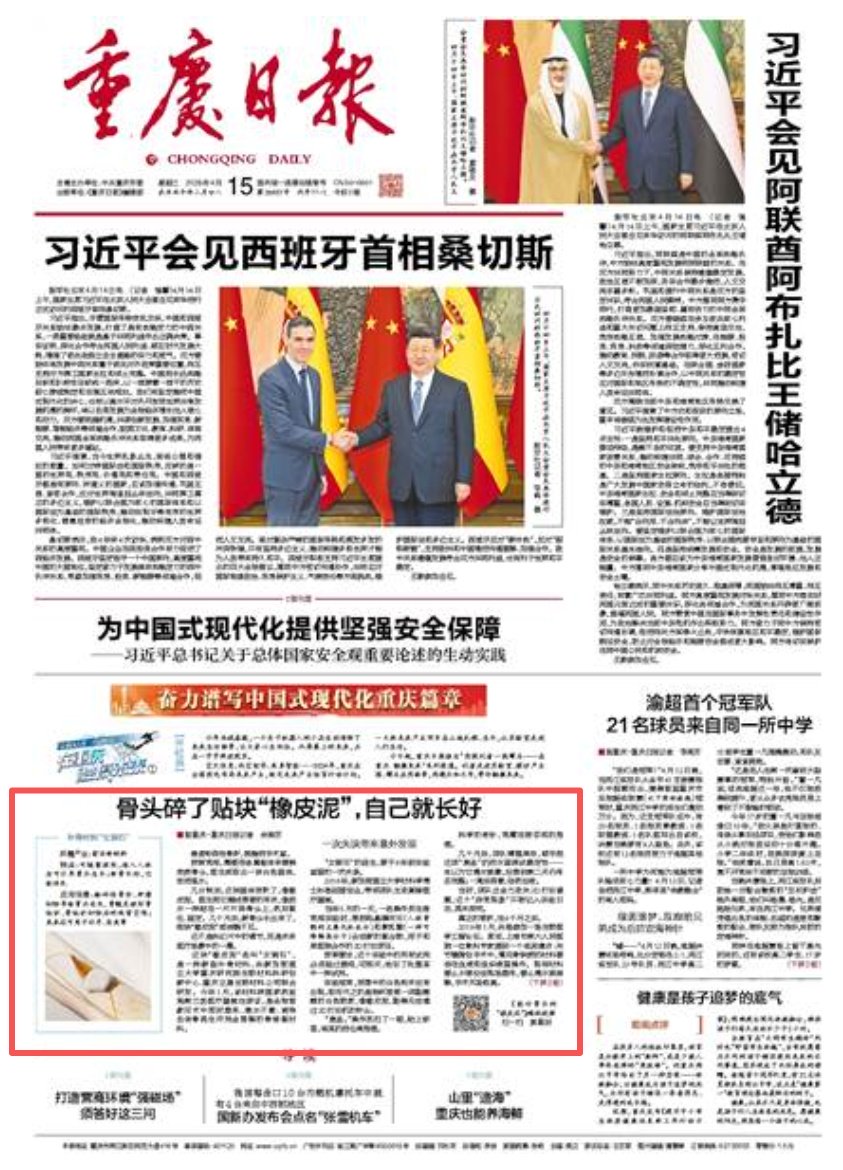
Source: New Chongqing – Chongqing Daily, Future Industry Office of Chongqing Municipal Commission of Economy and Information Technology
Disclaimer: Unless otherwise stated for original content, articles and images are sourced from the internet and major mainstream media. Copyright belongs to the original authors. Please contact us for removal if infringement is suspected.