

Contact us
- Chongqing Industrial Design Promotion Center
- No. 1, Shangqingsi Road, Yuzhong District, Chongqing, People's Republic of China
- +86-23-60332626
- [email protected]

This year’s CCTV Spring Festival Gala featured a robot-themed skit that vividly depicted future life scenarios, inspiring widespread longing. And the future shown on screen is gradually becoming reality.
Space information, low-altitude economy, embodied intelligence… In 2024, Chongqing took the lead nationally in laying out future industries and formulating an action plan for their cultivation. A large number of future industry projects have taken root and grown in the mountain city, moving from laboratories into people’s lives.
The “Touching the Future in Chongqing” series takes you into laboratories, industrial parks, and application scenarios, using images and words to help you feel the future.
Industry category: Space information.
Features: Like a precision rifle with a scope, it enables laser “bullets” to accurately hit fast-moving targets with minimal energy loss.
Application scenarios: Mid-air charging for drones and flying cars, civilian low-altitude security, nuclear fusion ignition, mobile phone charging, air-ground communication, and more.
In the early morning, thin clouds drift across a clear sky. A lush green farmland stretches out, where an agricultural drone unfolds its rotors, takes off into the morning light, and methodically sprays fertilizer over the crop rows. After about 30 minutes of continuous operation, its battery runs low.
Just then, a sharp beam of light shoots out from a ground device, precisely locking onto a small battery panel on the drone’s body. The drone continues its work unaffected. No matter how it moves, the beam follows it like a shadow, continuously delivering laser energy to the onboard panel. Soon, the drone’s battery is fully recharged.
Scenes like this will soon become part of our daily lives.
“Our technology can target the eye of a needle from 1 kilometer away, turning the laser power transmission seen in science fiction films into reality,” said Ma Xiaoyu, founder and chief scientist of Chongqing Lianxin Intelligent Technology Research Institute Co., Ltd. (hereinafter referred to as Lianxin Technology). The company leverages China’s only and world-leading adaptive optics technology to achieve laser directed energy control, pioneering a new track in laser power transmission. In the future, the applications of this technology will extend far beyond charging drones in mid-air, holding immense potential to transform the landscape of energy utilization.
Low-altitude aircraft such as drones and flying cars are rapidly entering the market, but their limited range remains a critical bottleneck.
调研显示,消费级无人机飞行二三十分钟就需换电池,工业级无人机也仅能续航四五十分钟;尚在试点的飞行汽车,空中续航仅100~200公里,飞行不到40分钟就得落地充电。且这类飞行器电池笨重,想要长续航就无法兼顾机身轻巧及经济性,行业迫切需要远距离空中补能技术。

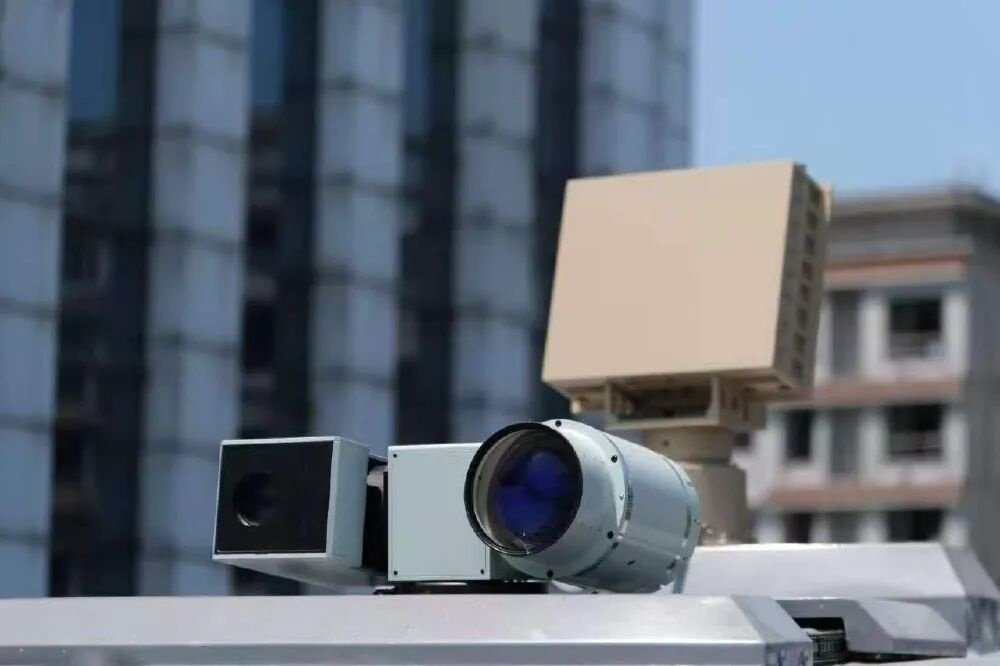
▲ Laser directed energy device. Photo provided by Lianxin Technology.
“Laser power transmission is precisely the solution to the range anxiety of low-altitude aircraft,” Ma Xiaoyu stated. The principle is clear: Equip the aircraft with a specialized laser battery panel and install a laser transmitter on the ground. The transmitter emits laser light to transmit optical energy, and the on-board panel converts it into electricity, enabling uninterrupted mid-air power supply.
Efficient laser power transmission, aside from high electrical-optical-electrical conversion efficiency, crucially requires that the laser can be accurately aimed and stably delivered. This demands cutting-edge technical support.
Lianxin Technology’s confidence comes from its self-developed second-generation adaptive optics system technology. This technology, unique in China and world-leading, originated from the Institute of Optics and Electronics, Chinese Academy of Sciences (IOE, CAS). It once broke foreign monopolies and elevated China’s astronomical observation capabilities to world-class levels.
In 2019, the IOE, CAS promoted the industrialization of this technology. Ma Xiaoyu, then a scientist at the institute, volunteered and founded Lianxin Technology in Chongqing, using laser beam control technology as a breakthrough to begin the transformation of advanced technology for civilian use.
The technological path from astronomical observation to laser power transmission was fraught with challenges.
Lianxin’s R&D team initially tried to directly adapt their existing technical parameters. Dozens of experiments failed.
The second-generation adaptive optics system, originally used for astronomical observation, relies on a laser guide star to counteract the distorting effects of atmospheric turbulence on starlight, enabling telescopes to see clearly. It only needed low-power lasers and performed well against weak turbulence.
Laser power transmission, however, requires high-power lasers and faces far more severe environmental challenges. Low-altitude atmospheric turbulence is more intense, making the laser beam more prone to jitter, drift, and divergence, causing serious distortion. The high-power laser heats the air, producing a “thermal blooming effect”—like shining a flashlight through steam rising from hot soup, the beam scatters and wobbles due to multiple refractions by the hot air, exacerbating the drift. Furthermore, high-power lasers impose a massive thermal load on optical components, easily causing lenses to deform from heat or even be damaged. This causes optical path deviations inside the system itself, creating a thorny laser thermal management problem. During transmission, the system must also precisely track the fast-moving aircraft.
Equally daunting was the cost. The original adaptive optics system cost tens of millions of yuan, making widespread adoption impossible. The United States has been researching laser power transmission since the 1990s but has yet to achieve large-scale deployment, partly because of the prohibitive cost.
Faced with the dual challenges of technology and cost, the team decided to completely restructure the original system. They adopted extended target wavefront sensors, deformable mirror correction algorithms with a small number of actuators, and dedicated parallel data processing chips to enhance the system’s ability to correct beam distortion. High-speed cameras capture the retro-reflection (light returning from the target after being illuminated by the laser) and automatically adjust the beam direction, improving dynamic tracking accuracy.
To solve the laser thermal management problem, the team designed an actively cooled optical path to reduce heat buildup at the source and protect the lenses. Meanwhile, they used algorithms to predict the direction of optical path deviations within the system and correct them in real time—like a driver anticipating a pothole ahead and steering early.
They also integrated AI algorithms into the beam combining technology for the high-power laser’s multiple fibers. This “smart brain” for beam combining takes the output of multiple fiber laser arrays and combines them into a single beam, breaking through the power ceiling of a single laser.
After thousands of experiments, the team finally overcame all technical bottlenecks, developing the laser directed energy control technology and the laser directed energy device.
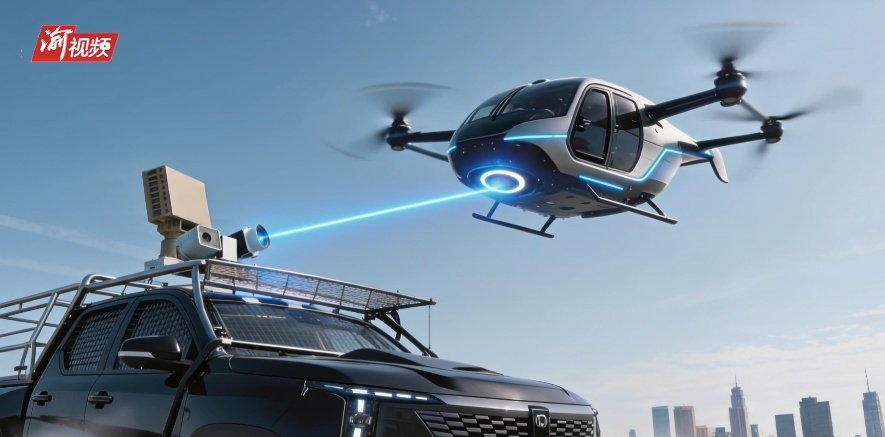
▲ Laser directed energy transmission. Video screenshot
Ma Xiaoyu offered an analogy: “If the laser is the ‘bullet,’ our device is the precision rifle with a high-quality scope.”
The capabilities of this “technological rifle” are exceptional. It senses and corrects the beam direction thousands of times per second based on real-time atmospheric and target trajectory data. It can track targets moving at over 60 meters per second within a 20-kilometer range, with an error of just 1 millimeter at 1 kilometer—far exceeding the accuracy of foreign counterparts. Its optical-to-electrical conversion efficiency reaches 21%, approaching the physical limits and is three to four times that of traditional methods. The cost, size, and weight of the device have all been reduced to one-tenth of the original, completely clearing the cost barriers to industrialization.
After leaving the lab, the laser directed energy device quickly made a name for itself.
In 2023, a national competition on laser power transmission technology was held in Siziwang Banner, Inner Mongolia. The rules were simple: within five minutes, transmit as much energy as possible to stationary and moving battery panels. Competing against 70 other teams from universities and research institutes, Lianxin Technology swept the competition, winning first place in both the stationary and moving target categories. Even its worst scores were five times better than the best scores of the runners-up.
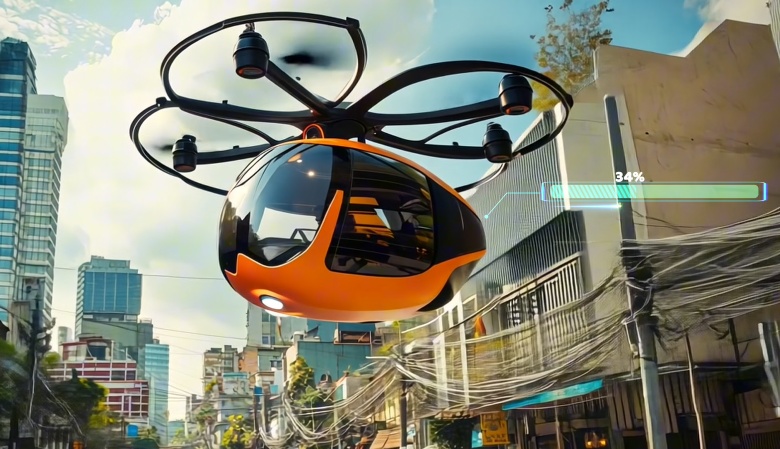
▲ Laser power transmission used to charge flying cars for extended range. Video screenshot
Leveraging its core technological advantages, Lianxin Technology has become the only private enterprise in China with both the adaptive optics-based laser directed energy device and the full-chain capabilities for industrialization.
In February 2026, the company partnered with the Shanghai Institute of Optics and Fine Mechanics, Chinese Academy of Sciences, to establish a new company focused on laser power transmission, pushing forward industrialization with an initial focus on two core areas.
首先发力的是无人机空中充电。截至2025年末,我国实名登记无人机超328万架,激光传能不但可彻底解决无人机续航短板,还能解决无人机管控难的问题,市场空间广阔。
Second, the new company is entering the civilian low-altitude security sector, developing laser defense devices for precise countermeasures against “rogue” drones. A vehicle-mounted version is already available, and a man-portable shoulder-fired version is expected to be launched in June this year.
Ma Xiaoyu revealed that several investment funds are finalizing their investments in Lianxin Technology. This year, the company will fully launch its two core business segments.
The application value of laser power transmission extends far beyond the low-altitude economy. Ma Xiaoyu stated that as technology evolves and costs drop, this technology will unlock many more full-coverage application scenarios, fundamentally changing traditional energy supply methods.
After flying cars become widespread, laser power transmission could enable continuous mid-air charging. With just a small backup battery, a flying car could achieve unlimited cross-city range. In power grid maintenance, laser technology could be used to remotely de-ice high-voltage lines from several kilometers away, replacing dangerous manual labor and improving efficiency and safety. In telecommunications, it could integrate laser power transmission with communication, solving the problems of susceptibility to interference and poor stability in air-ground communication.

▲ Laser power transmission for charging small devices like phones and laptops. Video screenshot
Other potential applications include nuclear fusion ignition and material surface heat treatment. At shorter ranges, it could provide wireless charging for small electronic devices like phones and laptops without dead spots indoors. In the future, laser power transmission infrastructure might become as common as cell towers, integrated into industrial production, daily life, aerospace, and more, breaking the limitations of traditional wired and short-range wireless charging and creating a new paradigm of full-coverage wireless energy transmission.
Source: New Chongqing – Chongqing Daily
Disclaimer: Unless otherwise stated for original content, articles and images are sourced from the internet and major mainstream media. Copyright belongs to the original authors. Please contact us for removal if infringement is suspected.