
Contact us
- Chongqing Industrial Design Promotion Center
- No. 1, Shangqingsi Road, Yuzhong District, Chongqing, People's Republic of China
- +86-23-60332626
- [email protected]

This year’s CCTV Spring Festival Gala featured a robot-themed skit that vividly depicted future life scenarios, inspiring widespread longing. And the future shown on screen is gradually becoming reality.
Space information, low-altitude economy, embodied intelligence… In 2024, Chongqing took the lead nationally in laying out future industries and formulating an action plan for their cultivation. A large number of future industry projects have taken root and grown in the mountain city, moving from laboratories into people’s lives.
The “Touching the Future in Chongqing” series takes you into laboratories, industrial parks, and application scenarios, using images and words to help you feel the future.
Industry category: Advanced new materials.
Features: Achieves zero blood contamination and damage, prevents hemolysis and thrombosis, and aims to halve the price of domestically produced fully magnetic levitation artificial hearts.
Application scenarios: A world-leading treatment for heart failure patients.
In a quiet, solemn operating room, a minimally invasive cardiac surgery is underway. The surgeon makes a small incision in the patient’s chest and precisely implants a compact fully magnetic levitation artificial heart into the left ventricle. When powered on, the blood pump inside the artificial heart instantly activates. Its impeller levitates in mid-air, spinning at high speed, pushing blood throughout the body without friction.
This is not a scene from a science fiction novel, but a new technology that has already been realized and will gradually be rolled out in the future.
As the core component of the third-generation fully magnetic levitation artificial heart, this blood pump is precisely what Chongqing Kaici Medical Technology Co., Ltd. (hereinafter referred to as Kaici Medical) has manufactured. It achieves zero blood contamination and damage, fundamentally preventing fatal complications such as hemolysis and thrombosis, and is key to replacing imports with domestically produced high-end medical devices.
With an aging population and the increasing prevalence of cardiovascular disease, heart failure has become a major public health challenge in China.
According to research forecasts, the number of heart failure patients in China is expected to reach 22.7 million by 2035, an increase of over 70% from 2021. Artificial hearts are a critical tool in addressing this risk.
The core of an artificial heart is the blood pump that drives blood flow. It acts like a “micro-engine” inside the heart, pumping blood from the left ventricle into the aorta. Its technical level directly determines the efficacy and safety of the artificial heart.
Zheng Shijie, General Manager of Kaici Medical, explained that artificial heart blood pumps have gone through three generations of iteration. The current third-generation fully magnetic levitation blood pump uses electromagnetic forces to make the impeller levitate and spin without contacting the pump housing, achieving “zero contamination and zero damage” to blood and fundamentally preventing complications. This represents the global forefront of research and development.
However, this technology was long monopolized by the United States. Products from international giant Abbott once held 90% of the global market share, with a single imported device costing over one million yuan, putting it out of reach for most domestic patients.
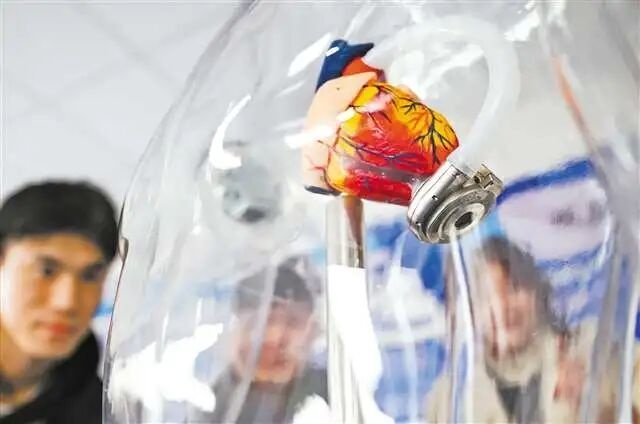
▲ At Chongqing Kaici Medical Technology Co., Ltd., a model shows the implantation site of the fully magnetic levitation blood pump within the human body and how it assists the heart in pumping blood. Photo by reporter Zhang Jinhui / Visual Chongqing
To break through the patent barriers, China chose an axial fully magnetic levitation technological path different from the radial structure used in the United States—with the motor and impeller stacked vertically. This allowed China to successfully achieve a technological breakthrough.
Kaici Medical, located in Liangjiang New Area, is a key player in this path, accelerating the domestic production of third-generation fully magnetic levitation artificial hearts with this Chongqing-made pump core.
“Come take a look. This is the internal structure of Kaici Medical’s fully magnetic levitation blood pump,” Zheng Shijie said, showing the reporter the remarkable device in the company’s exhibition hall.
It is compact, with a silver-white casing. Inside the circular pump chamber, a white, streamlined impeller rests lightly against the inner wall of the housing.
“Now, let’s power it on.” As Zheng Shijie pressed the button, the impeller instantly “levitated,” reaching 5,000 revolutions per minute. “At this point, a 1-millimeter gap forms between the impeller and the pump wall.”
It is this unassuming 1-millimeter gap that enables zero contact between blood and the pump body, allowing up to 10 liters of blood to flow out per minute and be delivered throughout the body. This eliminates both frictional blood damage and contamination, “creating” a precious lifeline for the patient.
The development of this “pump core” did not happen overnight.
In 2008, a team led by Professor Hu Yefa from Wuhan University of Technology, a partner of Kaici Medical, initiated foundational research on magnetic levitation blood pumps in response to major national needs.
Over the following decade, the team secured core patents for axial-flow artificial heart pumps and achieved comprehensive breakthroughs in areas such as centrifugal blood pumps, rotor control, and flow field optimization.
But technological breakthroughs were just the first step. In 2023, Kaici Medical began promoting the standardized, large-scale production of its fully magnetic levitation blood pumps.
This proved to be no easy task.
The reason the impeller can “float” is due to the magnetic fields generated by electromagnetic coils inside the pump housing, which create repulsive forces with the magnetic materials on the impeller, “levitating” it from multiple directions (top, bottom, left, right, front, back).
However, variations in coil winding processes, turn count errors, and installation positions cause differences in the magnitude of the electromagnetic forces. This leads to deviations in the impeller’s levitation position and can cause rotational jamming. “I remember in 2024, our first batch of products off the line were like the Seven Calabash Brothers—they looked similar but each had subtle differences. The product qualification rate was less than 50%,” Zheng Shijie recalled.
The solution? The factory conducted repeated experiments, introduced standardized molds, and continuously improved process equipment, finally reducing the deviation in the impeller’s levitation position from 100 microns to about 10 microns, achieving smooth rotation.
To date, Kaici Medical has successfully delivered over 300 fully magnetic levitation blood pumps, with a product qualification rate of 100%.
At present, this Chongqing-made “pump core” has not only broken through technical difficulties, but also is committed to opening up the “last mile” of large-scale application.
While Kaici Medical has achieved small-scale production of its fully magnetic levitation blood pump, the widespread clinical application of the fully magnetic levitation artificial heart still has a long way to go.
Zheng Shijie candidly acknowledged two major challenges currently facing the industry: high cost (domestically produced artificial hearts, including surgical fees, still exceed one million yuan, making them unaffordable for ordinary patients), and technological fragmentation (various medical device manufacturers duplicating R&D efforts, slowing down the pace of marketization).
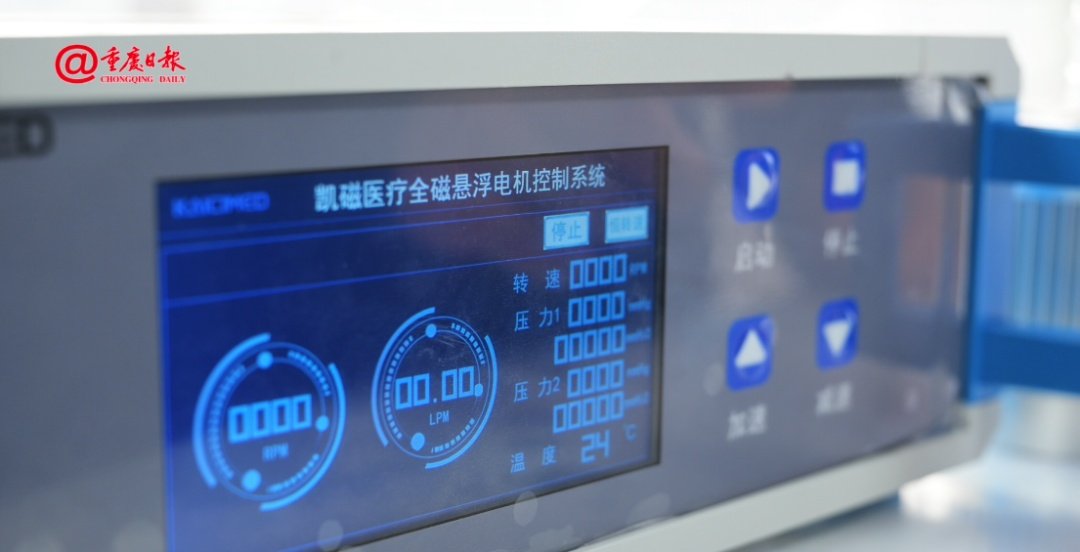
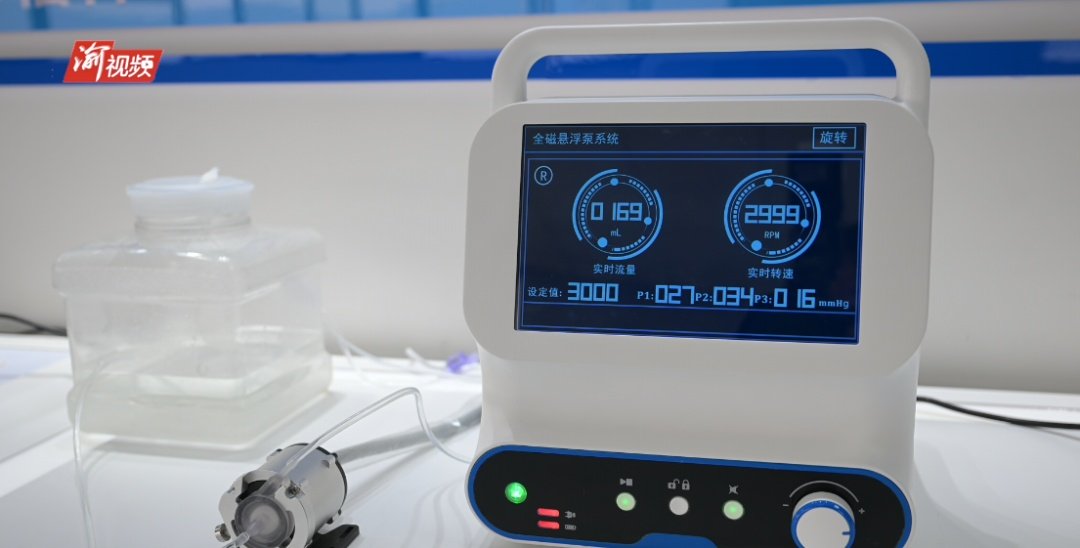
▲ Kaici Medical’s fully magnetic levitation motor control system. Video screenshot
As a core component manufacturer, Kaici Medical has taken a different path: rather than producing the entire artificial heart, it focuses on being a supplier of fully magnetic levitation blood pumps, providing core technology support to all medical device manufacturers.
This choice avoids the 5-8 year clinical and review cycle associated with innovative medical devices, while allowing the entire industry to share access to core fully magnetic levitation technology, accelerating the development of China’s artificial heart industry cluster.
Several medical device manufacturers are already using Kaici Medical’s fully magnetic levitation blood pumps to conduct animal experiments and clinical trials. One is expected to obtain a Class III medical device certificate as early as this year, allowing artificial hearts equipped with the Chongqing-made “pump core” to truly enter clinical use and benefit patients.
Even more promising, as production scales up, the unit price of the blood pump is expected to drop significantly. Kaici Medical projects delivering 500 blood pumps in 2026, which could reduce the cost of domestically produced fully magnetic levitation artificial hearts by at least 50%.
Nor is that all. The value of this Chongqing-made fully magnetic levitation blood pump extends far beyond artificial hearts. Zheng Shijie indicated that its technology has broad application prospects in fields such as artificial lungs, artificial livers, and artificial wombs.
With its globally leading technology, flexible production model, and high cost-performance ratio, the product is already highly competitive internationally. In the future, Kaici Medical aims to accelerate its expansion into overseas markets, striving to achieve over 100 million yuan in output value by 2030, and to propel Chinese high-end medical equipment onto the world stage with this Chongqing-made “pump core.”
Source: New Chongqing – Chongqing Daily, Future Industry Office of Chongqing Municipal Commission of Economy and Information Technology
Disclaimer: Unless otherwise stated for original content, articles and images are sourced from the internet and major mainstream media. Copyright belongs to the original authors. Please contact us for removal if infringement is suspected.