

Contact us
- Chongqing Industrial Design Promotion Center
- No. 1, Shangqingsi Road, Yuzhong District, Chongqing, People's Republic of China
- +86-23-60332626
- [email protected]

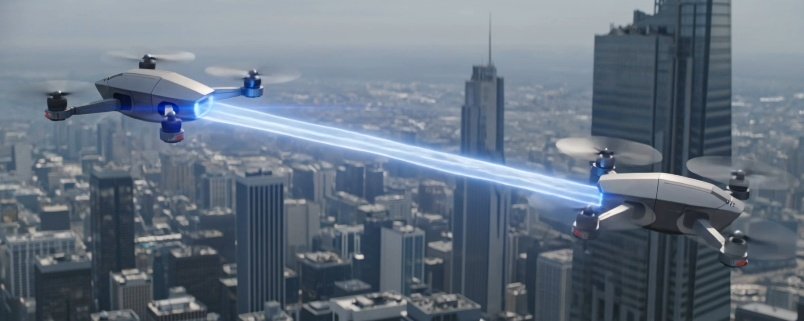
This year’s CCTV Spring Festival Gala featured a robot-themed skit that vividly depicted future life scenarios, inspiring widespread longing. And the future shown on screen is gradually becoming reality.
Space information, low-altitude economy, embodied intelligence… In 2024, Chongqing took the lead nationally in laying out future industries and formulating an action plan for their cultivation. A large number of future industry projects have taken root and grown in the mountain city, moving from laboratories into people’s lives.
The “Touching the Future in Chongqing” series takes you into laboratories, industrial parks, and application scenarios, using images and words to help you feel the future.
Industry category: Space information.
Features: Enables one drone to track and lock onto another using AI algorithms and hardware sensing.
Application scenarios: Aerial security, patrols at large-scale events, etc.
As evening lights come on, crowds gather on Chongqing’s Nanbin Road. Over the river, a drone light show is about to begin.
In the darkness, several FPV drones coated with stealth paint skim the water’s surface, approaching restricted airspace in an attempt to disrupt the performance.
At the critical moment, over a dozen security drones take to the air, quickly locking onto the intruders’ flight paths. After a brief aerial confrontation, the rogue drones are successfully cornered and captured.
This future scenario may or may not happen. But the “anti-drone with drones” technology developed by CloudWalk Technology has the capability to subdue rogue drones, weaving a low-altitude security net for our future cities.
With the development of the low-altitude economy, the application scenarios for drones are increasing. At the same time, preventing and controlling “rogue flights”—unauthorized drone flights or incursions into no-fly zones—has become a challenge for urban security.
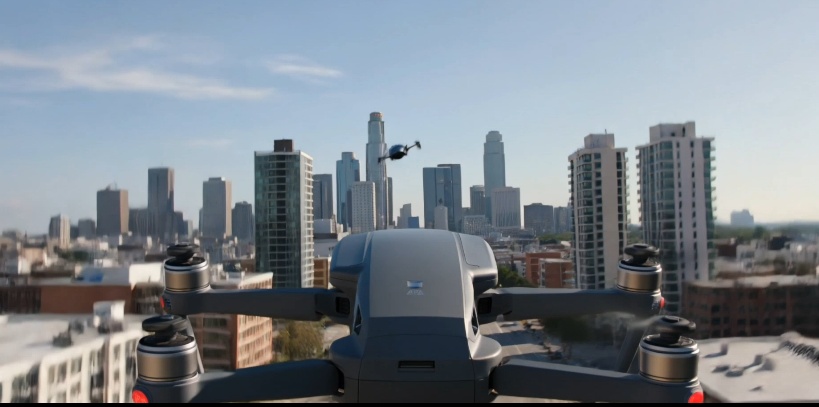
▲ “Anti-drone with drones” technology. Video screenshot
Currently, the global methods for countering rogue drones are primarily ground-based. These include electronic jamming, laser weapons, and missile interception. However, each of these methods has limitations.
For example, electronic jamming devices emit radio waves that either drown out the communication signals between other drones and their controllers like noise, or “spoof” BeiDou/GPS signals, ultimately causing the target drone to lose connection or force-land. However, these methods have a wide coverage area and are indiscriminate, easily causing “collateral damage” to legitimately flying drones and potentially interfering with mobile phone, civilian base station, and broadcast television signals.
Laser weapons can emit high-energy laser beams to burn through a drone’s shell, circuit board, motor, and camera. However, this method is heavily affected by weather conditions. Rain, fog, haze, and sandstorms can scatter the laser, significantly reducing its range and power.
Using missiles to intercept small drones is mainly employed in “geopolitical conflicts,” such as the US-Iran conflict where missiles were used to down drones. This approach is not suitable for general urban environments, as it is like “using a sledgehammer to crack a nut”—the cost is too high.
More critically, traditional counter-drone technologies are mostly fixed deployments. When facing highly maneuverable rogue drones, they often fall into the awkward situation of being able to see them but not catch them.
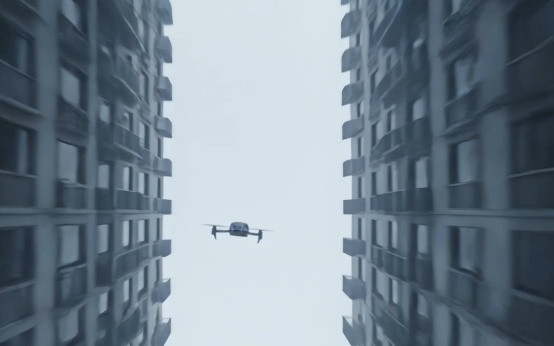
▲ Small drones are difficult for conventional ground equipment to precisely capture. Video screenshot
“Today’s consumer-grade drones are increasingly difficult to catch,” admitted Zhang Chunhui, an algorithm researcher at CloudWalk Technology. Small drones have a radar cross-section of just 0.01 square meters but can fly at speeds of up to 60 kilometers per hour, making them impossible for conventional ground equipment to precisely target.
With drone technology constantly advancing, traditional “ground-to-air” defense systems have fallen behind. There is an urgent need to upgrade low-altitude defense technology. CloudWalk Technology is targeting “air-to-air” drone tracking technology, attempting to solve the air defense challenge from the air.
Having one drone track and counter another high-speed drone in mid-air is a technical challenge worldwide.
“It’s like someone on a high-speed train trying to precisely aim a camera at a car moving in the same direction,” Zhang Chunhui likened. Both the tracker and the target are in high-speed dynamic motion, facing challenges like scale changes, motion blur, and terrain occlusion. The technical threshold is extremely high.
Previously, there was no mature theoretical or technical system globally.
In 2024, CloudWalk Technology began its exploration. The breakthrough started with data—only by accumulating enough data on drone flights could the AI algorithm accurately identify and lock onto targets.
The R&D team traveled across China, collecting massive amounts of drone sample data, recording the flight postures and motion characteristics of various drone models. They covered complex environments like water-skimming flight, tree occlusion, and weaving between buildings; adverse weather conditions like heavy rain and dense fog; and various evasive maneuvers including sudden acceleration, 90-degree sharp turns, and hovering stealth.
In 2024, CloudWalk Technology, together with Shanghai Jiao Tong University and the Hong Kong University of Science and Technology (Guangzhou), released the world’s first million-scale multimodal anti-drone visual tracking benchmark dataset for “air-to-air” scenarios. This “encyclopedia of aerial tracking” for the low-altitude field contains 1,810 video sequences, over 1.05 million frames, and a duration of nearly 9.85 hours.

▲ CloudWalk Technology released the world’s first million-scale multimodal anti-drone visual tracking benchmark dataset for “air-to-air” scenarios. Video screenshot
With this data, CloudWalk Technology’s “air-to-air” tracking algorithm acts like a seasoned “aerial hunter,” possessing keen visual recognition, powerful trajectory memory, and precise semantic understanding. Even if the target drone occupies only 20 to 30 pixels in the frame—about one-tenth the size of a pinky fingernail—the algorithm can still lock onto it accurately. It can also automatically filter out distractions like birds and plastic bags, keeping its focus on the target without losing it.
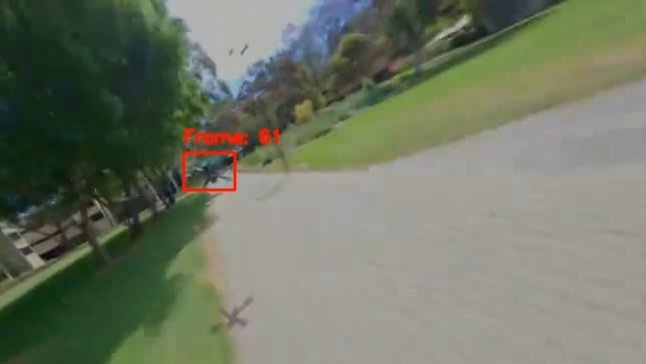
▲ The “air-to-air” tracking algorithm precisely locks onto its target. Video screenshot
Currently, this technology relies primarily on visual tracking. Future plans include incorporating infrared sensors and neuromorphic sensors to ensure accurate capture at night and in adverse weather like heavy fog. There are also long-term plans to introduce 4D camera technology to complement visual tracking, achieving all-environment, no-blind-spot aerial tracking.
If the “air-to-air” tracking technology is deployed on a large scale, the urban low-altitude defense model could shift from “passive defense” to “active patrol,” greatly improving security efficiency and precision.
An “aerial patrol force” of security drones could then patrol the skies above a city 24/7. Upon detecting a rogue drone incursion, they could immediately lock onto the target, track and warn it. If the rogue drone fails to comply, countermeasures could be deployed to neutralize the aerial risk in a timely manner.
The application scenarios for this technology are vast. Beyond daily defense in urban airspace, during major events and important meetings, it could create a two-tier defense line of “ground defense + aerial interception,” creating a robust low-altitude safety barrier.
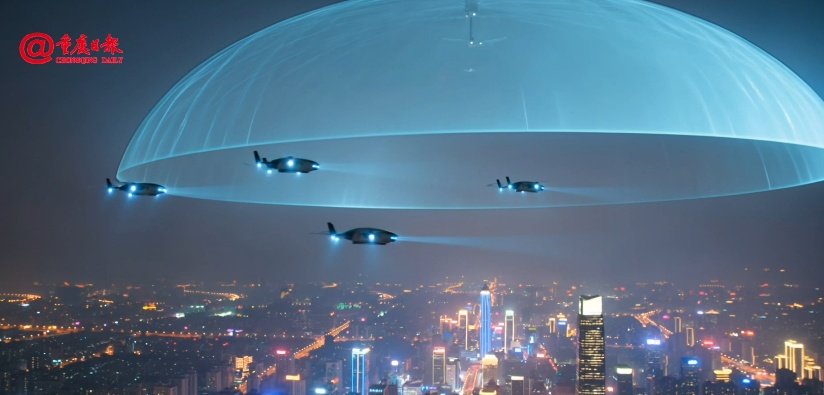
▲ “Air-to-air” tracking technology builds a robust low-altitude safety barrier for cities. Video screenshot
For a city like Chongqing, with its many mountains and rivers, this technology can also effectively cover traditional defense blind spots like river surfaces and valleys, plugging gaps in low-altitude security and achieving complete low-altitude control for the mountain city.
In the future, with the support of artificial intelligence, the “air-to-air” technology could be further upgraded: security drones could autonomously recharge, deploy, and dispatch, reducing the need for human intervention. When facing a swarm of hostile drones, multiple security drones could form a collaborative combat cluster, dividing tasks and executing precise interceptions.
Perhaps such a scenario will become a reality in the near future.
Source: New Chongqing – Chongqing Daily
Disclaimer: Unless otherwise stated for original content, articles and images are sourced from the internet and major mainstream media. Copyright belongs to the original authors. Please contact us for removal if infringement is suspected.