
Contact us
- Chongqing Industrial Design Promotion Center
- No. 1, Shangqingsi Road, Yuzhong District, Chongqing, People's Republic of China
- +86-23-60332626
- [email protected]

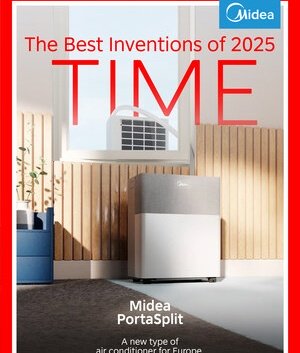
As extreme summer heatwaves swept across multiple European countries in 2026, a Chinese-original portable split air conditioner sparked a consumer buying frenzy—Midea’s PortaSplit sold out across core European markets including Germany, France, the UK, and the Netherlands, with resale prices reaching two to three times the original retail value. Local consumers drove up to 200 kilometers and paid premium prices to get their hands on the unit, and paid inventory tracking platforms emerged to provide real-time restock updates from thousands of stores across Europe. Behind this explosive market performance lies a classic example of Midea leveraging industrial design to break through regional market barriers.
With a household air conditioning penetration rate of only 20%—far below the global average—the European market has long faced three persistent bottlenecks that have also hindered traditional AC brands from expanding into the region:
First, strict regulations on historic and protected buildings in many European cities prohibit wall drilling for modifications, making traditional split-type air conditioner installation impossible. Second, certified installation technicians are scarce and expensive, with labor costs often exceeding €1,000—far higher than the unit price of the AC itself—creating a prohibitively high barrier to entry. Third, Europe has a large rental population; traditional fixed-installation AC units cannot be taken when moving, and tenants are unwilling to invest heavily in property improvements.
Midea‘s local European team, deeply immersed in the regional market, accurately identified these pain points and collaborated with domestic R&D teams and an Italian professional industrial design firm. After three years of development, they created the PortaSplit portable split air conditioner. The product features an innovative window-mounting design with a variety of adapter brackets. The outdoor unit weighs less than 10 kilograms, requiring no wall drilling or professional tools—ordinary users can complete the entire installation independently in just ten minutes. This hardcore innovative design has earned global recognition, with the product being named to TIME’s Best Inventions of 2025 and winning both the German Innovation Award and the iF International Design Award.
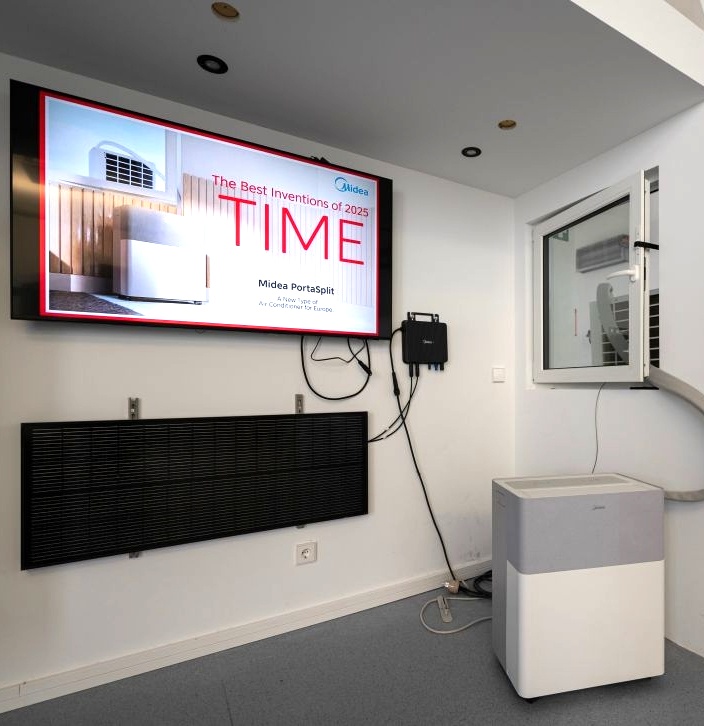
Fu Jian, President of Midea International, noted that PortaSplit is the result of global R&D collaboration and deep local adaptation: from product weight and noise optimization to the selection of eco-friendly refrigerants, every aspect was tailored to match Europe‘s climate characteristics, heritage building regulations, and consumer habits. It is a typical example of Midea’s localization strategy in action.
Midea currently operates 29 design and R&D centers across 11 overseas countries, building a differentiated product development system where “local insights lead the way and global technical resources collaborate.” Dedicated solutions are customized for different regional markets:
● North America: Modular low-temperature heat pump ducted units reduce installation time by 60%, adapting to harsh cold climates.
● Middle East: V8 multi-split units feature ShieldBox IP55 fully enclosed electrical control protection technology, operating stably at extreme temperatures of up to 60°C.
● Latin America: Long-lasting anti-corrosion coatings on the units, paired with custom inverter systems, adapt to high-temperature, high-humidity environments, helping the brand maintain the top market share in Brazil and Egypt for years.
Localized innovation continues to translate into business results. In 2025, Midea‘s overseas revenue reached RMB 195.9 billion, up 15.9% year-on-year, while the share of own-brand revenue in overseas smart home products exceeded 45%, moving away from low-cost OEM models and achieving brand value export.
Unlike most export brands that rely on homogeneous products and price-driven competition to capture overseas markets, Midea has completely broken away from the industry‘s traditional competitive logic. The company insists on original industrial design as its core differentiator, with deep, localized user insights as its foundation, subverting outdated industry standards and rigid product forms in overseas home appliance markets. PortaSplit’s global success is not a short-term market fluke but the inevitable outcome of Midea‘s long-term commitment to localized innovation and independent technology and design. This disruptive product not only precisely solved a decades-old industry pain point in the European market but also filled a gap in regional cooling products. It stands as a landmark achievement for Chinese design in the global premium consumer market.
With its lightweight innovative structure, tool-free installation, and ultimate localized adaptation, PortaSplit broke through three seemingly insurmountable market barriers—heritage building regulations, high installation costs, and rental mobility—delivering an essential cooling solution to European households with a superior user experience. Moving beyond simple hardware exports to a comprehensive value proposition encompassing core technology, original design, brand philosophy, and local services, Midea has completely abandoned the traditional low-end path of OEM and white-label manufacturing. Leveraging the strengths of Sino-Italian collaborative design and global R&D synergy, the product achieves a comprehensive upgrade in function, experience, aesthetics, and adaptability, earning recognition from both global consumers and industry authorities. Looking ahead, Midea will continue to draw on user insights, original design, and global collaboration as its pillars, consistently delivering Chinese innovation, Chinese design, and Chinese smart manufacturing, showcasing the strength of Chinese brands on the global industrial stage.
Source: Chongqing City of Design WeChat Official Account
Compiled and written by: Liao Zhengdong
Edited by: Yang Jianing
Reviewed by: Huang Tao