

Contact us
- Chongqing Industrial Design Promotion Center
- No. 1, Shangqingsi Road, Yuzhong District, Chongqing, People's Republic of China
- +86-23-60332626
- [email protected]

Editor’s Note: Record highs and nine consecutive increases! Over the past year, the total value of China’s goods trade imports and exports grew by 3.8%, reaching 45.47 trillion yuan, a record high, maintaining its position as the world’s largest trader in goods. Among this, Chongqing emerged as a standout performer, with its total annual import and export value exceeding 800 billion yuan, a year-on-year increase of 12%. “Chongqing-Made” products have transformed from laptop computers being the sole standout to a situation where “multiple highlights are blossoming.”
Chongqing Daily is launching the “‘Chongqing-Made’ Goes Global” series of reports, telling the stories of “Chongqing-Made” products traveling across oceans, decoding the advanced code of Chongqing manufacturing’s journey from “going out” to “going steady” and “going far,” and showcasing the robust strength of “Made in China.”
Yupai Fashion is the collective term for Chongqing‘s regional apparel industry. Its core characteristics are “mountain city adaptability + Sichuan-Chongqing cultural integration + customization” and cluster collaboration. Representative enterprises are concentrated in four key areas: high-end customization, intangible cultural heritage cheongsam, business menswear, and regional womenswear.
Yupai Fashion started from individual workshops in the 1980s, growing through wholesale and retail markets at Chaotianmen and Xinhua Road. It has produced a number of local brands including Duanji Suit, Tianpai, Shuwang, Junlin Cheongsam, Yadi Garments, and Yimeiji.
Although Chongqing‘s clothing exports account for a relatively small share of the national total (about 1-2%), they have shown rapid growth in recent years. In 2025, Chongqing’s clothing exports grew 10.6% year-on-year, making it one of the few regions maintaining high growth rates.
Customization is the ”pinnacle“ of the apparel industry, representing the highest level of craftsmanship and branding. High-net-worth individuals in Europe regard custom clothing as a subtle expression of status and taste, with London‘s Savile Row, Parisian haute couture, and Milanese tailoring dominating the international premium customization market for decades.
In recent years, a Chongqing-based company has successfully broken into this market, with “high-end customization + group uniforms” at its core and “cross-border e-commerce + small-batch quick response” as its path. Riding the “Made in China” flagship, it has achieved brand globalization. From 2022 to 2025, the company‘s export revenue grew from RMB 20 million to RMB 100 million.
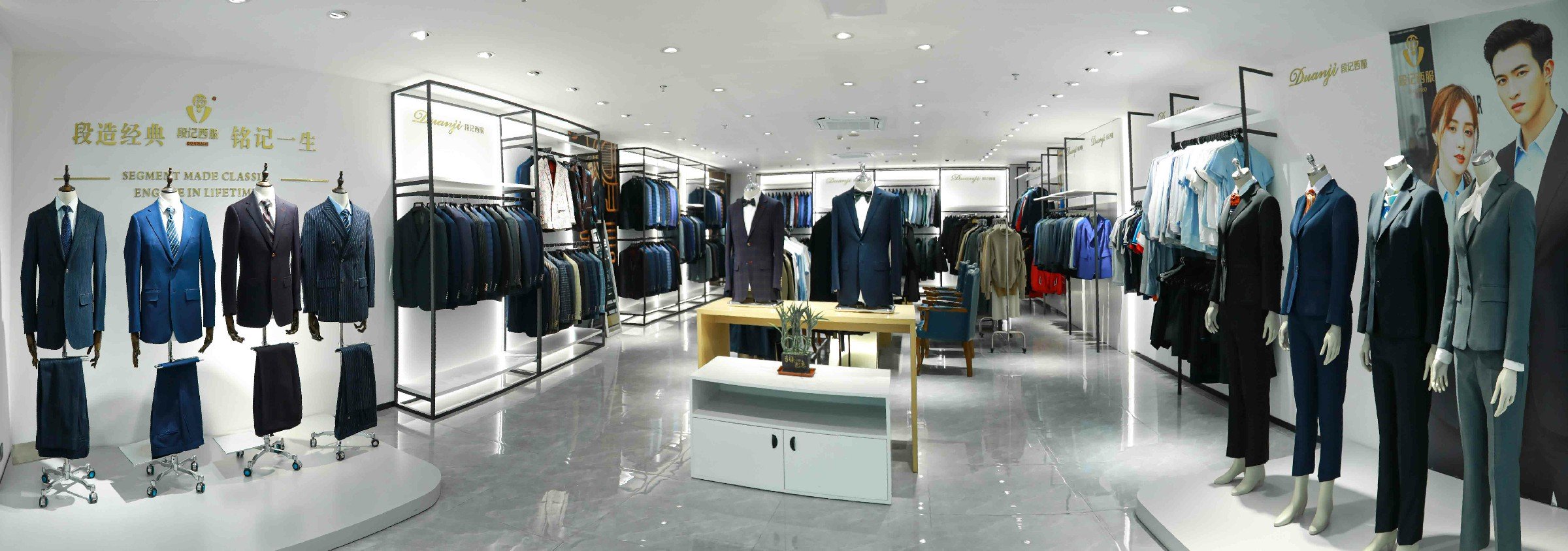
这家企业就是重庆市段记服饰有限公司(以下简称段记服饰),是渝派服饰定制领域的龙头企业,旗下拥有品牌“段记西服”。

▲ Duanji Suit headquarters in Liangjiang New Area. Photo provided by the company.
Duanji Garment started as a tailor shop in Daxing Village, Jiangbei District. In 1980, founder Duan Yuanhong set up a tailor shop called “Duanji Garment” there, specializing in suit making, and obtained one of Chongqing‘s first individual business licenses in 1982.
In 1985, Duanji Garment moved into the Chongqing Department Store at Jiefangbei. From then on, leveraging department stores like Chongqing Department Store and New Century, the business focused on custom clothing. At that time, these department stores sold both ready-made garments and fabrics; after buying fabric, customers could have it tailored by Duan Yuanhong’s team.
In 2001, Duan Yuanhong shifted the company‘s focus to export apparel, doing OEM manufacturing based on foreign client specifications and sample requirements.
During this period, Duanji Garment not only introduced advanced equipment from Germany, Italy, and Japan to upgrade its production lines but also collaborated with Italian experts to improve tailoring techniques and optimize patterns and molds. The company’s production capacity, craftsmanship, and product quality all improved significantly.
In 2009, Duanji Garment made a major strategic shift: moving the business focus from OEM back to mid-to-high-end customization, with a focus on expanding the small-group uniform market.
The main reason was that the labor-intensive export apparel industry was showing signs of shifting to Southeast Asia, and domestic OEM profit margins and industry scale were continuously shrinking.
Accordingly, Duanji Garment adopted a franchise model and quickly established sales channels across 31 provinces, autonomous regions, and municipalities, securing numerous small-group uniform orders. To date, the company has served over 1 million enterprises, with over 98 million cumulative private customization orders.
In 2014, “Duanji Suit” was awarded the title of China Well-Known Trademark, and the company achieved annual sales of RMB 1.5 billion.
In 2022, Duanji Garment made a major strategic decision: implementing a “cross-border customization” strategy and officially entering overseas markets.
This new export model differs fundamentally from the company‘s previous approach: at the brand level, it now exports its own brand “Duanji Suit” instead of OEM products; at the customer level, it serves overseas enterprises or individual clients directly, rather than other apparel companies; and at the product level, it focuses on small-group uniforms rather than large-volume ready-made garments.
In short, it replicates the company‘s proven “premium customization + group uniform” model in overseas markets.
In terms of expansion strategy, Duanji Garment also made a significant adjustment: abandoning the previously successful franchise model in favor of a “cross-border e-commerce + small-batch quick response” model.
The core reason is that the e-commerce-driven “small-batch quick response” model had created significant market challenges for Duanji Garment in previous years.
“Small-batch quick response” is a flexible supply chain model in the apparel industry. Its core is accepting small-batch orders, completing design, sampling, production, and delivery at the fastest speed, while quickly responding to market feedback for reorders and product adjustments. Essentially “production to order,” it avoids inventory risks while accommodating personalized consumer demands.
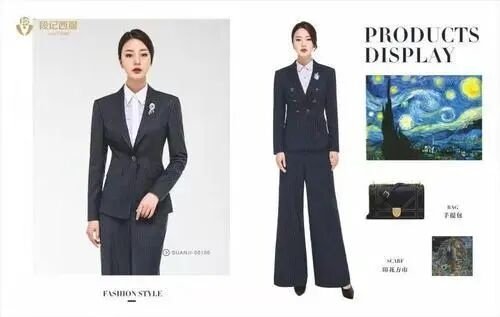

▲ Duanji Suit products. Photo provided by the company.
From 2015 onward, with the rapid growth of e-commerce, platforms like Shein led apparel clusters in Xintang (Guangzhou) and Dalang (Dongguan) to trial flexible production lines and explore flexible transformation.
From 2020 to 2022, orders became increasingly fragmented, inventory risks surged, and “production to order” became necessary for industry survival. During this phase, the “small-batch quick response” model rapidly gained traction in China. Duanji Garment, which had relied on small orders for its market advantage, faced a flood of new competitors, severely impacting its business and causing annual sales to decline sharply.
“If you can‘t beat them, learn from them!” Duan Yuanhong said. Starting in 2022, the company not only adopted the “e-commerce + small-batch quick response” model but also applied it to exports, achieving a kind of “disruptive advantage.”
To this end, Duanji Garment assembled four domestic livestream teams and two cross-border e-commerce teams to expand both domestic and international markets simultaneously.
After four years of dedication, the results are emerging: on the domestic front, the regional sales team was streamlined from over 100 to just over 10 staff, significantly reducing operating costs while stabilizing sales volume. On the international front, through participation in international trade shows and establishing a presence on platforms like TikTok and Alibaba International, the company has achieved brand globalization. In 2025, the company‘s products entered eight European and American countries, with overseas sales reaching RMB 100 million—more than four times the 2022 figure.
In China’s apparel industry, Duanji Garment is only a “small boat” in terms of both output value and export volume. It has not established overseas stores or warehouses. Why has it successfully achieved “cross-border customization” globalization?
“Mainly because it‘s easier to sail out when following a big ship!” Duan Yuanhong said. In recent years, the “Made in China” big ship has gained widespread recognition in international markets, making Chinese apparel products more readily accepted internationally.
Through accumulated OEM experience and ongoing technological innovation, China’s apparel industry has gradually shed its “OEM” and “cheap” labels, with production processes and product quality now fully competitive with European and American counterparts.
Duanji Garment‘s multiple honors—including “China Well-Known Trademark,” “China’s Leading Corporate Uniform Enterprise,” “China Top 100 Garment Enterprise,” and “National Exemption from Quality Inspection”—have also significantly lowered market entry barriers for its global expansion.
Additionally, the deep integration of China‘s full-chain apparel supply chain, flexible manufacturing advantages, and cross-border e-commerce capabilities creates “small-batch quick response” strengths that better serve overseas personalized and fast-fashion demands.
For example, using its big data and AI technology, Duanji Garment can automatically measure clients by having them upload just three photos (front, side, and back), completing the process in under a minute. Orders are delivered in 14 to 21 days—far shorter than the 35- to 45-day delivery cycles typical in European and American markets.
China’s apparel e-commerce penetration rate has exceeded 70%, roughly twice that of European and American countries.
Duan Yuanhong believes that although Chongqing‘s Yupai fashion enterprises are inland, generally small in scale, face a lack of overseas offline channels, and struggle to enter foreign department stores and boutiques, they can seize the market opportunity presented by the booming ”small-batch quick response“ model. By leveraging China’s domestic supply chain, flexible manufacturing, and cross-border e-commerce strengths, combined with Chongqing‘s strategic location along the New International Land-Sea Trade Corridor, the future for Yupai fashion exports is bright.
Source: New Chongqing – Chongqing Daily
Disclaimer: Unless otherwise stated, text and images are sourced from the internet and major media outlets. Copyright belongs to the original authors. Contact us for removal if infringement is suspected.