
Contact us
- Chongqing Industrial Design Promotion Center
- No. 1, Shangqingsi Road, Yuzhong District, Chongqing, People's Republic of China
- +86-23-60332626
- [email protected]

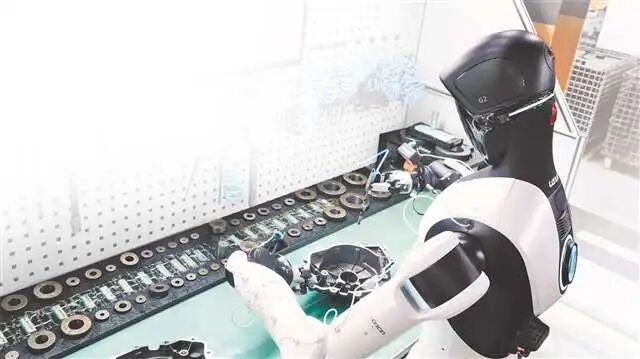
This year’s CCTV Spring Festival Gala featured a robot-themed skit that vividly depicted future life scenarios, inspiring widespread longing. And the future shown on screen is gradually becoming reality.
Space information, low-altitude economy, embodied intelligence… In 2024, Chongqing took the lead nationally in laying out future industries and formulating an action plan for their cultivation. A large number of future industry projects have taken root and grown in the mountain city, moving from laboratories into people’s lives.
The “Touching the Future in Chongqing” series takes you into laboratories, industrial parks, and application scenarios, using images and words to help you feel the future.
Industry category: Embodied intelligent robots.
Features: Highly flexible limbs and multimodal perception, capable of mimicking human touch to replicate precise movements.
Application scenarios: Discrete manufacturing with multiple varieties, small batches, and rapid iteration.
On a factory assembly line, a humanoid robot uses an electric wrench to tighten a screw. “Click!” Too much force—the thread is stripped.
A red warning immediately flashes on the nearby screen. The torque curve breaks sharply, and deviation data captured by the vision system is instantly recorded. Seconds later, the robot retracts its arm, then raises it again for another attempt.
For now, this scene can only be seen in a very small number of laboratories and test stations worldwide. But starting this year, more and more humanoid robots are expected to appear in Chongqing’s motorcycle factories.
In early 2026, Loncin, Shanghai Zhiyuan, and the Yongchuan District State-owned Assets Supervision and Administration Commission jointly launched the construction of a joint venture factory. It is expected to produce 10,000 humanoid robots this year, with 3,500 entering the motorcycle production lines of Zongshen and Loncin. They will serve as “apprentices” there, starting with the most fundamental yet hardest-to-teach task: tightening screws.
When it comes to “smart manufacturing” in factories, many people’s first reaction is: aren’t industrial robotic arms already used on assembly lines?
They are, and in some areas, they are highly mature. However, the vast majority of robotic arms are “fixed hands” on production lines. They are highly efficient in highly standardized scenarios, such as automotive assembly lines or chip packaging, where product models are fixed and production is batched, allowing the cost of installing robotic arms to be amortized over large order volumes.
But the situation changes completely when it comes to discrete manufacturing with multiple varieties, small batches, and rapid iteration.
The motorcycle industry is a typical example. This year, retro cruiser styles might be popular; next year, lightweight track-focused models; the year after, urban scooters… The production line must be adjusted frequently. With each adjustment, fixed robotic arms often require reprogramming, new fixtures, parameter changes, or even several days of complete line shutdown. The cost of these modifications can reach millions of yuan, and when amortized over just a few thousand orders, it becomes economically unviable.
What about relying solely on human labor? In a motorcycle workshop, a worker has to bend down to tighten over 800 screws per day on average. They deal not only with greasy hands but also with constant noise and vibration. The working conditions are tough, making it difficult to retain workers—a common challenge across the manufacturing industry.
Compounding this is the rising cost of labor. Li Yao, chairman of Loncin, has calculated the numbers: they have nearly 20,000 employees, with an average annual salary of 138,000 yuan, resulting in an annual payroll of 2.7 billion yuan.
“The motorcycle industry finds itself stuck in an awkward ‘gap zone,'” Li Yao said. If the production line is fully automated, it’s too expensive and too rigid to keep up with the pace of market updates. If it relies more on human labor, it faces issues like being unable to recruit or retain workers and rising costs.
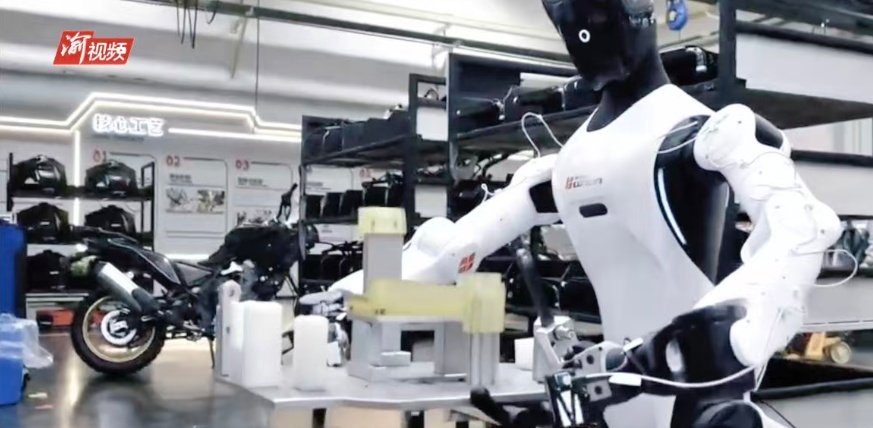
▲ Industrial-grade humanoid robot. Video screenshot
In fact, it’s not just Chongqing’s motorcycle companies that are “stuck in this gap,” but also millions of small and medium-sized discrete manufacturing enterprises across the country. These enterprises need a new type of workforce—one that combines the tirelessness of machines with the flexibility of humans to move around, change workstations, and adapt to non-standard environments.
There’s only one answer: humanoid robots.
At this year’s CCTV Spring Festival Gala, humanoid robots once again became a sensation with their impressive performances. This enthusiasm is reflected in industry data: in 2025, Shanghai Zhiyuan shipped more humanoid robots than any other company globally, surpassing the entire US industry combined.
This explosive growth is essentially the result of the deep integration of AI large models with humanoid bodies. As AI evolves from just a “brain” to having a physical body—becoming “embodied intelligence”—robots are no longer just machines following commands; they now have the ability to learn and replicate human actions.
However, most of these humanoid robots are currently used for greeting people in shopping malls, performing somersaults at exhibitions, or serving dishes in restaurants. Very few appear on the industrial front lines, where they would encounter grease, vibration, and dust.
The reason is simple: lack of data.
Laboratories can teach robots to fold clothes or do yoga because the environment is controllable. But a real engine assembly line is completely different: reflections from metal parts frequently cause vision systems to misjudge; vibrations from nearby stamping machines make the “hands” unstable; and oil contamination on sensors instantly distorts force feedback.
These non-standard details are difficult to fully replicate in a laboratory. As a result, AI companies lack the real, large-scale industrial data needed to deeply train humanoid robots, while manufacturing companies are unwilling to use their production lines as testbeds for immature robots.
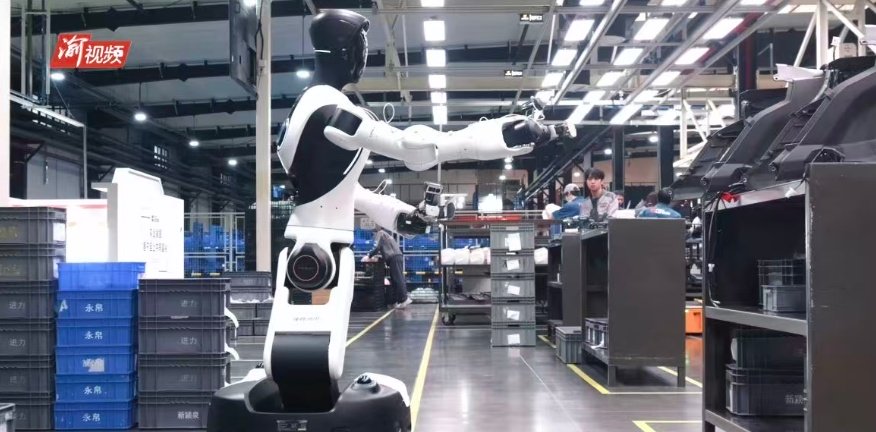
▲ Industrial-grade humanoid robot. Video screenshot
Chongqing companies, however, are determined to find a solution. At the end of 2024, Li Yao approached Shanghai Zhiyuan: “We have real factory environments, massive production data, and a quality management system honed over many years. These are things that can’t be simulated in a laboratory.” The two sides quickly reached an agreement.
According to the plan, these 3,500 humanoid robots will “learn” from human experts through a digital replication process—using high-precision vision sensors to “see” and record the motion trajectories of experienced workers; using torque sensors at the ends of their arms to “feel” the changes in force during screw tightening; and using backend AI large models to process and align this visual and force data in real time.
Through this method, the robots will gradually quantify the “tacit” feel of master workers—that sense which is known only through experience but difficult to articulate—into underlying code that machines can understand.
Starting with “screw tightening,” humanoid robots will collect data and learn on real factory floors. After several years of training, they could become “full-time employees” of the factory. Industry insiders predict that if this “simplest yet most challenging” attempt succeeds, it could spark a new revolution in smart manufacturing.
In Chongqing, for example, within the “33618” modern manufacturing cluster landscape, traditional advantageous industries such as motorcycles, general machinery, and precision components have long been squeezed between high automation costs and heavy reliance on manual labor. The large-scale application of humanoid robots could potentially solve both problems simultaneously.
Zuo Zongshen, chairman of Zongshen Group, believes that once the scale of application crosses a critical threshold, the unit price of humanoid robots could fall below 50,000 yuan. At that point, humanoid robots could become standard equipment in the workshops of small and medium-sized enterprises, further reducing manufacturing costs and enhancing competitiveness in both international and domestic markets.
With the large-scale application of humanoid robots in factories, China’s employment structure will also be upgraded. In Zuo Zongshen’s view, robots entering factories is not simply about “replacing people with machines,” but about upgrading people themselves.
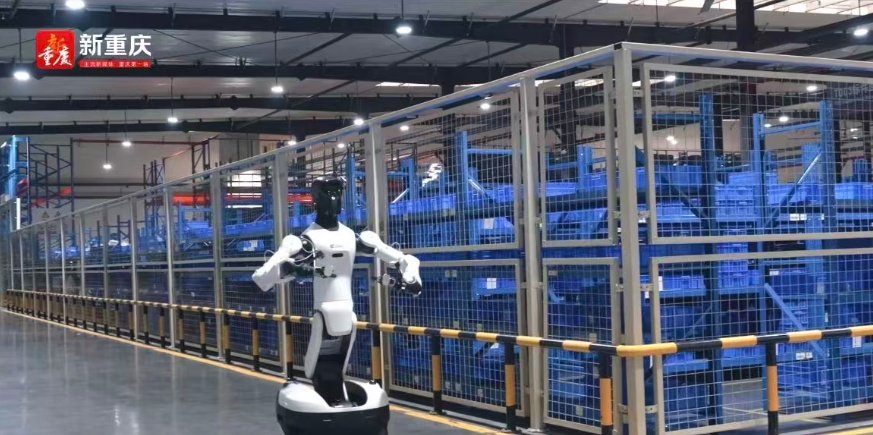
▲ Industrial-grade humanoid robot. Video screenshot
Zuo Zongshen explained that in the future, young people who were previously stuck in repetitive manual labor positions will transition from being greasy-handed screw workers to becoming humanoid robot operation and maintenance specialists, process optimization engineers, and data annotators. This transformation—from “selling physical labor” to “managing machines”—will not only increase the flexibility of production lines but also enhance the attractiveness and added value of manufacturing jobs in China.
This could also provide a benchmark for the global embodied intelligence industry.
In Li Yao’s view, if humanoid robots can successfully operate in complex environments with ultra-high quality management requirements like those at Loncin and Zongshen, they will have the capability to enter tens of thousands of discrete manufacturing factories worldwide. “This would be not just about exporting products, but about exporting ‘Chinese smart manufacturing’ standards.”
Source: New Chongqing – Chongqing Daily, Future Industry Office of Chongqing Municipal Commission of Economy and Information Technology
Disclaimer: Unless otherwise stated for original content, articles and images are sourced from the internet and major mainstream media. Copyright belongs to the original authors. Please contact us for removal if infringement is suspected.