

Contact us
- Chongqing Industrial Design Promotion Center
- No. 1, Shangqingsi Road, Yuzhong District, Chongqing, People's Republic of China
- +86-23-60332626
- [email protected]

In recent years, AITO automobiles have defined a new paradigm for premium mobility, while Qiteng’s quadruped explosion-proof robot has taken the lead in the specialized intelligent equipment track. Industrial design has become the core enabler for Chongqing’s manufacturing industry to leap to higher value in the industrial chain and achieve iterative upgrades.
As the only world “City of Design” in western China, cutting-edge creative concepts have deeply intersected with Chongqing’s century-old industrial heritage. A large number of “Chongqing Design” masterpieces—distinguished by their aesthetics, quality, strength, and potential—are emerging and gaining acclaim across the Bashu region.
From today onwards, the “Encountering Design·Shaping the Future” series will present a panoramic view of Chongqing’s landmark industrial design projects of 2025. Through words and lenses, the series will immerse you in the mutually reinforcing journey between industrial design and Chongqing manufacturing.
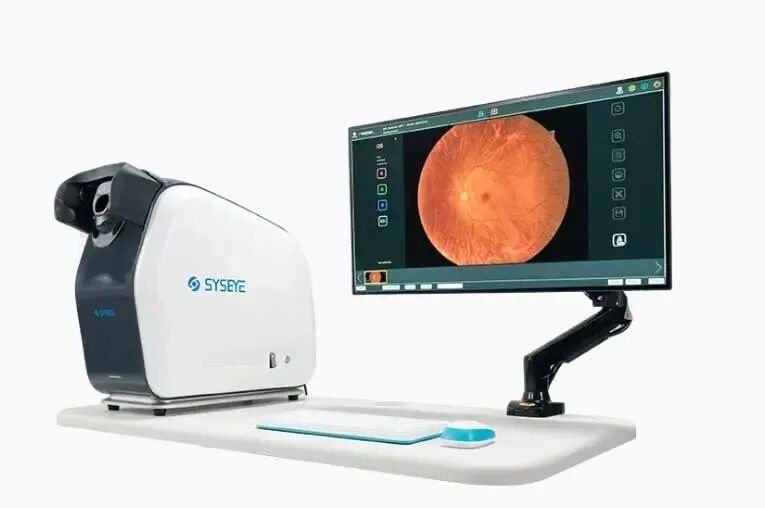
Conventional 45° fundus examination devices in China suffer from narrow fields of view and high miss rates. The examination requires pupil dilation, involves complex procedures, and offers a poor patient experience. Meanwhile, the high-end fundus device market has long been dominated by German and Japanese companies, with prices around 2 million yuan per unit, significantly raising the barrier to entry for primary healthcare institutions.
To break this foreign monopoly, Chongqing Beiao New Vision Medical Equipment Co., Ltd. leveraged industrial design in its R&D efforts, successfully launching the first domestically produced ultra-widefield true-color non-mydriatic fundus camera. The device features self-developed ultra-widefield optical scanning imaging technology, equipped with fully automatic alignment and focusing functions, delivering true-color high-definition imaging under white light. A single image captures a 176° field of view, surpassing the 133° range of comparable products from German Zeiss. The device can adapt to pupils as small as 2.8mm, eliminating the need for dilation. A single examination takes less than one minute. It supports offline AI analysis to protect patient data privacy and comes standard with a DICOM 3.0 interface for seamless integration with PACS systems, adapting to telemedicine scenarios.
With integrated hardware-software design, the product has evolved from a standalone imaging device into an intelligent diagnostic system, improving the detection rate of peripheral lesions in diabetic retinopathy from 82% to 98%. The product is priced at 680,000 yuan, significantly lowering the procurement cost for primary healthcare facilities. Leveraging its ultra-widefield imaging, small-pupil adaptability, and full-process automation, the product ranked first among domestically produced fundus cameras in China’s market share in 2025, with exports to Europe and the US exceeding 50% of its business. It has become a benchmark for domestic substitution in the ophthalmic medical device sector.
Massive intraoperative bleeding is a major safety risk that can threaten a patient’s life during surgery. Traditional catheter-based hemostasis methods have shortcomings such as difficulty controlling dosage, tube blockage, and insufficient spray pressure. Achieving efficient and precise hemostasis is a common challenge in both clinical surgery and device R&D.
Targeting this industry pain point, Chongqing Yuhai Industrial Design Research Institute spent two years tackling the challenge, completing the entire process from solution development, prototype testing, performance calibration, to mass production. It independently developed an intraoperative drug deliverer, successfully achieving domestic substitution in this critical medical device category. The design team systematically analyzed the full surgical workflow, identified clinical pain points, and continuously refined the product design. The device consists of a drug deliverer, hemostatic powder, and a spray catheter. It innovatively adopts a dual-airflow separation structure, separately channeling powder delivery and spray propulsion to ensure smooth powder output and precise spray positioning. The hemostatic powder uses a powder coating technology to solve the blockage problem. In clinical emergency treatment of upper gastrointestinal non-variceal bleeding, hemostasis can be achieved in as fast as 3 seconds—dramatically improving emergency efficiency compared to the 20-second hemostasis time of comparable foreign products. The product’s form factor draws inspiration from an electric charging gun, with an ergonomic design optimized for Asian hand sizes. It supports one-handed operation, reduces user fatigue, and is suitable for prolonged surgical use.
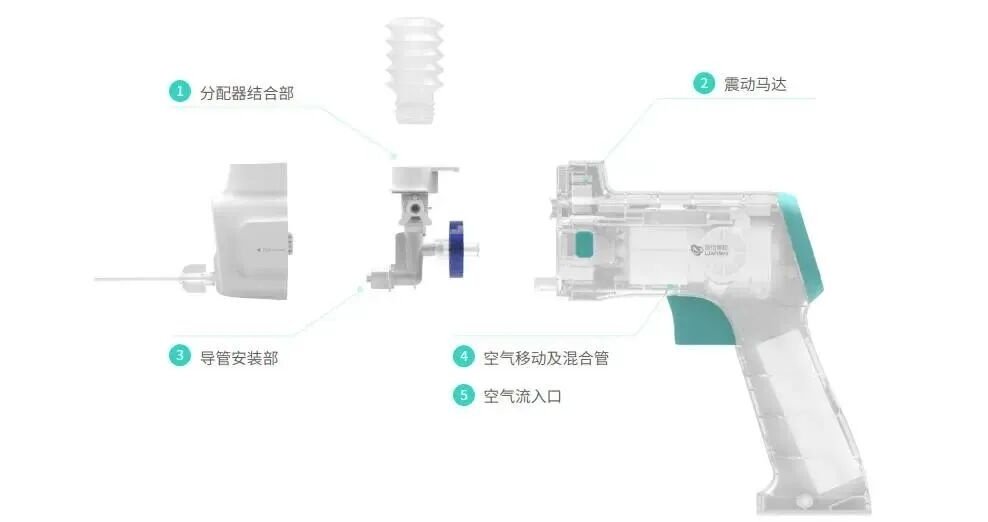
The product is currently in clinical use in the endoscopy departments of several top-tier hospitals, including Beijing Anzhen Hospital (Capital Medical University) and Jinshan Hospital (The First Affiliated Hospital of Chongqing Medical University). Its outstanding advantages—rapid hemostasis and ease of operation—have earned widespread recognition from clinical medical staff.