
Contact us
- Chongqing Industrial Design Promotion Center
- No. 1, Shangqingsi Road, Yuzhong District, Chongqing, People's Republic of China
- +86-23-60332626
- [email protected]


On February 12, JD Airlines’ first Airbus A330 freighter took off from Chongqing, operating the international cargo route from Chongqing to South Asia. Chongqing is located in the inland western region and is not traditionally a major foreign trade province. Why did JD choose Chongqing?
A sparrow alighting on a twig knows spring is coming before the warmth arrives.
Data from Chongqing Customs shows that in 2025, Chongqing’s total foreign trade import and export value exceeded 800 billion yuan, a year-on-year increase of 12%, with growth far exceeding the national average. Export products have transformed from laptop computers being the sole standout to a situation where “multiple highlights are blossoming”—ranging from general machinery, automobiles, and motorcycles to pharmaceuticals, eyewear, and apparel.
Amidst the current complex and volatile international environment, with slowing global trade growth and rising unilateralism and protectionism, how has “Chongqing-Made” managed to buck the trend?
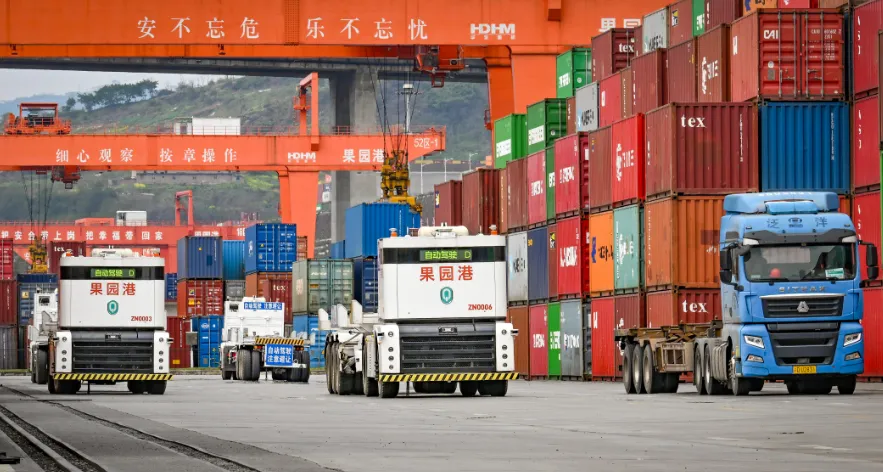
▲Chongqing’s Guoyuan Port is bustling with activity. Photo by reporter Zhang Jinhui / Visual Chongqing
Europe is the world’s premier motorcycle market. It is home to globally dominant brands like KTM and enforces the most stringent access requirements. In the past, Chinese motorcycles were labeled as “cheap” here. Today, Loncin Voge is shattering those prejudices through technological excellence.
In December 2025, British rider Ritchie completed a 4,000-mile winter test ride on her Voge DS900X in the freezing conditions of the Scottish Highlands. The vehicle demonstrated remarkable corrosion resistance. “I thought it would rust into scrap metal after one winter, but its actual performance was even more reliable than some expensive brands,” Ritchie said.
What Ritchie may not know is that to overcome the corrosion and oxidation challenges posed by salted icy roads in Northern Europe and the humid, hot climate of the Mediterranean, Loncin Voge introduced aerospace-grade anti-corrosion coating technology, conducted ratio experiments on over 200 types of specialty materials, and completed over 1,500 hours of extended-cycle testing.
And this is just one small part of Loncin Voge’s technological excellence.
A Spanish rider posted that his father initially believed this Chinese bike was “just a cheap temporary substitute.” But when this seasoned rider saw for himself the bike’s adjustable high-performance suspension system, the brake calipers supplied by a top-tier manufacturer, and the engine originating from the same source as some major European brands, he exclaimed, “Unbelievable.”
It’s not just motorcycles. Technological excellence is the winning formula that opens doors worldwide for all “Chongqing-Made” products.
When Qingling Motors first entered the Mediterranean market, customers not only demanded that vehicles “run for twenty years in the desert without falling apart” but also imposed stringent requirements such as “being able to park stationary on a 45-degree slope without even a millimeter of slippage.” Facing this challenge, the Qingling R&D team repeatedly simulated and calculated pressure thresholds, making micron-level optimizations to transmission gear ratios. Two months later at the test track, Qingling delivered a perfect response, earning a thumbs-up from the impressed client.
When Dajiang Power’s lawn mowers ventured into Europe, a client posed seemingly contradictory requirements: a compact body delivering 3.8 kW of rated power, operating noise below 60 decibels, and the ability to run continuously for over 17 hours on a full tank under 25% load. This was virtually unprecedented in the industry. “If others can’t do it, we’re determined to try!” Three months later, Dajiang Power delivered samples for client testing. The lawn mower performed flawlessly, and the client immediately praised: “I never expected a Chinese company to deliver such a high-quality product in such a short time!”
When enterprises are no longer satisfied with simply “meeting standards” but instead “exceed expectations” in responding to market demands, “Chongqing-Made” products open the doors to global markets.
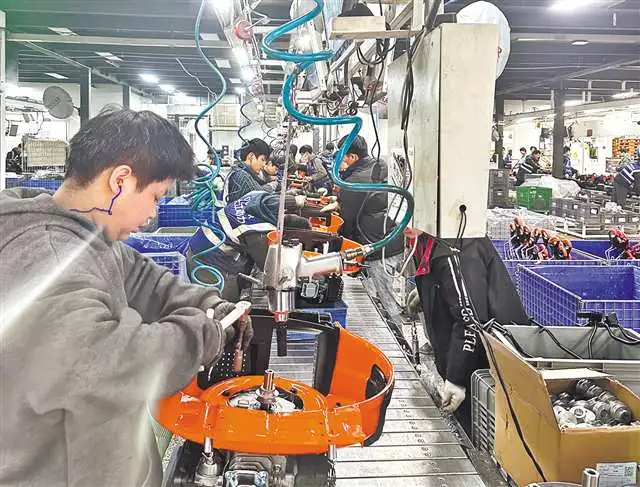
▲ Dajiang Power lawn mower production workshop. Photo by reporter Zhou Yu / Visual Chongqing
Even more encouraging is the transformation of “Chongqing-Made” exports from “OEM manufacturing” to “own brands.”
Senci Electric gave up hundreds of millions of dollars in annual OEM orders, withstood pressure from clients canceling cooperation and competitors encircling them, to develop its own brand. Today, its products hold about 10% of the U.S. small generator market.
Duanji Western-style Clothing explicitly decided to stop OEM manufacturing and instead export its own brand. In 2025, it successfully entered eight European and American countries, with overseas sales exceeding 100 million yuan.
No matter how good the product, it can still suffer from local unfamiliarity.
Numerous Chongqing enterprises stated in interviews that overseas markets are vastly different from the domestic market. A key reason Chinese manufactured products can enter and establish themselves is respect—respecting local environments and consumer habits, which ultimately wins customers.
In-depth market research has become crucial preparation for many Chongqing enterprises before going global.
Weima Agricultural Machinery discovered that Southeast Asia’s complex terrain presents challenges: large tractors can’t fit on narrow roads, harvesters can’t turn corners, and chassis easily get stuck in mud. To address this, they traveled throughout Southeast Asia, mapping local conditions: narrow terraced fields with steep slopes in central Vietnam; scattered coffee plantations with limited access in northern Thailand.
Shangfeng Technology spent nearly five years conducting research in various regions before going global. They found that in Africa and South America, where car ownership is low, tricycles serve the dual purpose of “personal transport + cargo hauling,” perfectly matching local needs. But specific requirements varied by country: relatively flat terrain in Indonesia suited flexible, medium-sized vehicles; Tanzania’s many potholed roads required vehicles with strong load capacity and high stability.
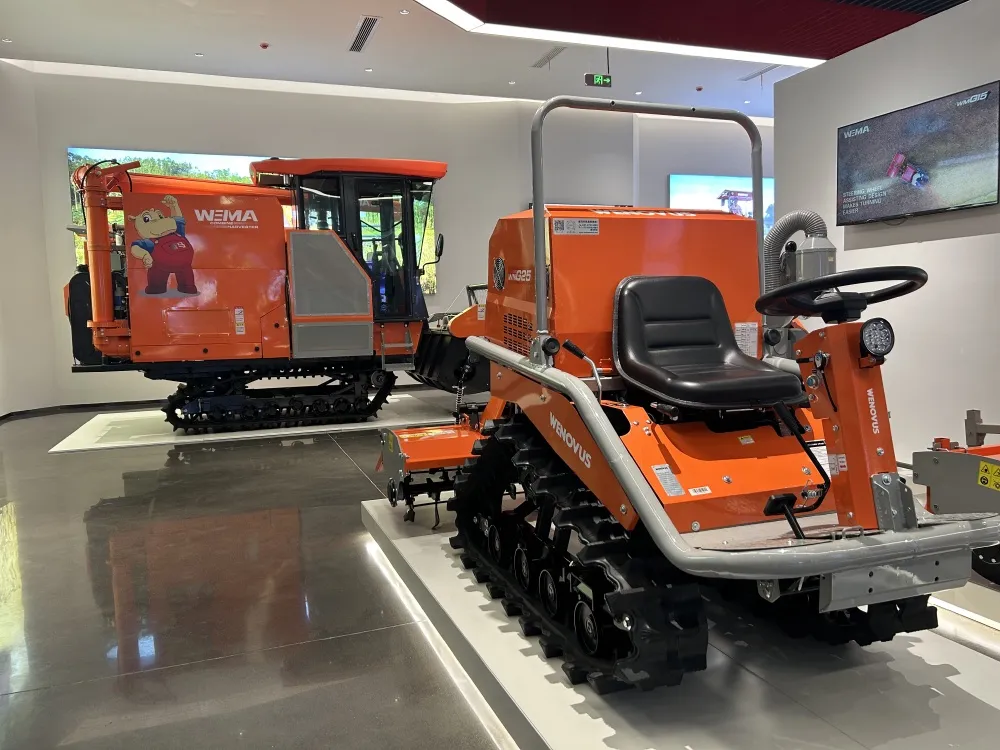
▲ Weima Agricultural Machinery’s export agricultural machinery products. Photo by reporter Xia Yuan
“Designing according to the terrain, modifying based on demand.” Chongqing enterprises develop different products for different markets.
Qingling Motors upgraded its standard pickups to four-wheel drive for Mediterranean desert conditions, adding tipper cargo boxes to suit local construction and agricultural needs. For Central Asia’s extreme cold environment, it launched hydrogen-powered heavy trucks.
Weima Agricultural Machinery’s products developed for Southeast Asia use lightweight, high-strength bodies suitable for manual transport and narrow roads. They feature self-developed transmissions compatible with multiple functions like rotary tillage, ridging, ditching, and weeding, achieving “one machine doing the work of many.”
Senci Electric’s products for developed countries focus on “storage durability,” with thicker casings and better sound insulation. Products for less developed regions emphasize “durability,” streamlining non-essential features beyond power generation to offer better cost-performance.
This sincerity in fully respecting local markets and tailoring products accordingly has yielded returns in both user recognition and market share.
In the first three quarters of 2025, Loncin Voge’s export revenue reached 1.718 billion yuan, a substantial year-on-year increase of 86.92%, with Europe becoming its primary export market.
In 2025, Dajiang Power topped the global sales chart for gasoline-powered lawn mowers with 1.05 million units exported and 4 billion yuan in sales revenue.
In 2025, Shangfeng Technology’s “first year” of going global saw its tricycles sold to over 30 countries including Tanzania and Angola, with 16,000 units sold and sales nearing 100 million yuan.
The accelerated global expansion of “Chongqing-Made” products also stems from China’s doors opening wider.
The “circle of friends” for co-building the Belt and Road Initiative continues to expand, with over 150 countries and 30 international organizations having signed cooperation documents to date.
The China International Import Expo (CIIE), the China International Fair for Trade in Services (CIFTIS), and the China International Consumer Products Expo (CICPE) have established a synergistic framework known as the “three-expo linkage.” Together, they form a comprehensive exhibition matrix that spans imports, exports, and trade in services, reflecting China’s commitment to all-around opening-up.
Although Chongqing is located in the inland hinterland, it has exhausted every means to accelerate its construction as an inland open highland and comprehensive inland open hub. In terms of open channels, Chongqing has built a multimodal transport system covering “east, west, north, south” and “rail, highway, water, air,” including the New International Land-Sea Trade Corridor, China-Europe Railway Express, Yangtze River Golden Waterway, and Chongqing-Manzhouli-Russia Railway. These channels not only shorten the spatial and temporal distance between Chongqing and overseas markets but also reduce logistics costs and enhance the competitiveness of “Chongqing-Made” products. The New International Land-Sea Trade Corridor alone helps “Chongqing-Made” products reach 584 ports across 127 countries and regions worldwide, reducing comprehensive container costs by 25%.
In terms of platform development, Chongqing has established an open platform system consisting of “one pilot free trade zone, seven comprehensive bonded zones, 14 bonded supervision sites, and nine customs-designated supervision sites.” These platforms effectively reduce enterprise operating and transaction costs, serving as core vehicles for aggregating foreign trade resources, cultivating foreign trade entities, and expanding the foreign trade industry. In 2025, the city’s seven comprehensive bonded zones achieved imports and exports totaling 492.77 billion yuan, accounting for 61.5% of Chongqing’s total foreign trade value and becoming the “ballast stone” of the city’s foreign trade sector.
In terms of regulatory innovation, Chongqing has leveraged the China-Singapore (Chongqing) Strategic Connectivity Demonstration Project to explore pioneering measures such as the “single bill of lading system” and “port of departure tax rebates,” streamlining import and export procedures for enterprises, accelerating customs clearance, and reducing costs. Notably, in the comprehensive pilot program for expanding the opening-up of the service sector, 31 innovative initiatives from Chongqing have been recognized as national best practice cases.
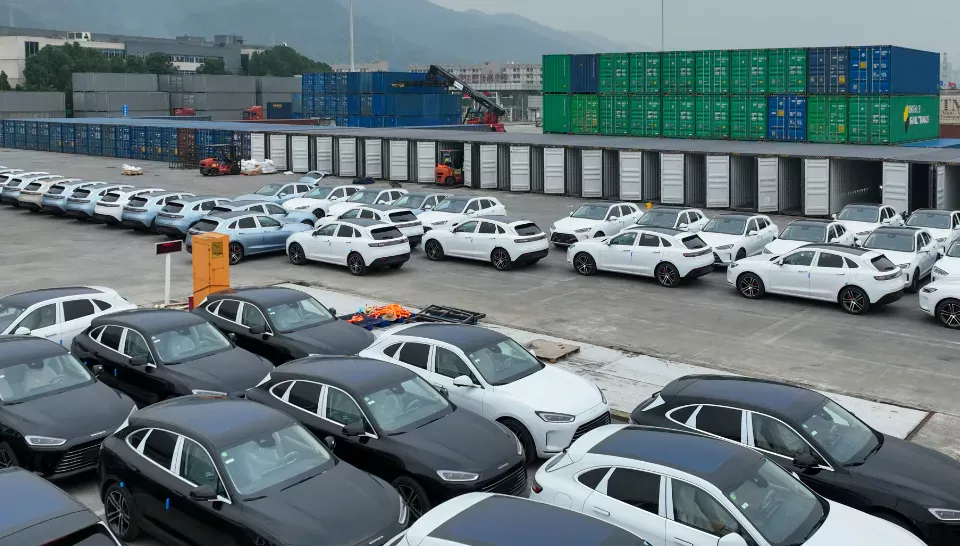
▲Vehicles parked next to containers at Chongqing Railway Port. Photo by reporter Zhang Jinhui / Visual Chongqing
With these combined effects, Chongqing’s open landscape has been transformed, moving from the “open periphery” to the “open frontier.”
Foreign trade categories are continuously optimizing. In 2025, three out of every ten laptops exported from China were produced in Chongqing, with export value firmly ranking first nationwide. Mobile phone, automobile, and motorcycle export values grew by 35.4%, 23%, and 29.5% respectively. Export growth for the “new three items” (electric vehicles, lithium-ion batteries, and photovoltaic products) reached 73.5%.
Trading partners are gradually increasing. In 2025, Chongqing conducted trade with approximately 230 countries and regions, achieving growth in imports and exports with nearly 180 countries and regions. ASEAN and the EU are Chongqing’s top two trading partners, with annual imports and exports growing by 12.6% and 10.2% respectively. Imports and exports to emerging markets like Latin America, Africa, and Central Asia grew by 22.3%, 38.7%, and 92.4% respectively.
Foreign trade entities continue to increase. In 2025, Chongqing had over 5,000 business entities with import and export records, a record high in recent years. Among them, private enterprise imports and exports grew by 18.9%, and state-owned enterprise imports and exports grew by 24.6%.
A time will come to ride the wind and cleave the waves; I’ll set my cloud-white sail and cross the vast seas.
Building the foundation for going global with technological excellence, deeply cultivating global markets with local wisdom, and erecting bridges with an open ecosystem—”Chongqing-Made” is writing more compelling chapters of “conquering the world” on the global stage through decade-long perseverance, the wisdom of adapting to local conditions, and the mindset of embracing the world.
Source: New Chongqing – Chongqing Daily
Disclaimer: Unless otherwise stated for original content, articles and images are sourced from the internet and major mainstream media. Copyright belongs to the original authors. Please contact us for removal if infringement is suspected.