
Contact us
- Chongqing Industrial Design Promotion Center
- No. 1, Shangqingsi Road, Yuzhong District, Chongqing, People's Republic of China
- +86-23-60332626
- [email protected]

Editor’s Note: Record highs and nine consecutive increases! Over the past year, the total value of China’s goods trade imports and exports grew by 3.8%, reaching 45.47 trillion yuan, a record high, maintaining its position as the world’s largest trader in goods. Among this, Chongqing emerged as a standout performer, with its total annual import and export value exceeding 800 billion yuan, a year-on-year increase of 12%. “Chongqing-Made” products have transformed from laptop computers being the sole standout to a situation where “multiple highlights are blossoming.”
Chongqing Daily is launching the “‘Chongqing-Made’ Goes Global” series of reports, telling the stories of “Chongqing-Made” products traveling across oceans, decoding the advanced code of Chongqing manufacturing’s journey from “going out” to “going steady” and “going far,” and showcasing the robust strength of “Made in China.”
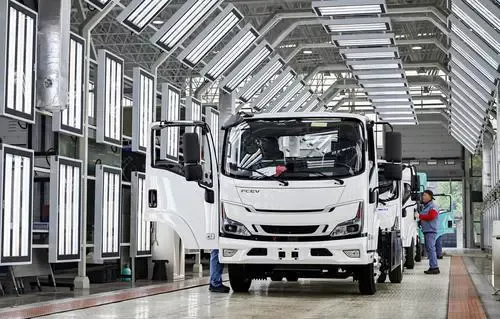
Chongqing is a national hub for automobile manufacturing, gathering 19 complete vehicle enterprises and over 1,200 component manufacturers. The scale of the automotive industry cluster has exceeded 800 billion yuan.
In 2025, Chongqing’s automobile production reached 2.788 million vehicles, reclaiming its title as “China’s Auto Capital.” In the same year, Chongqing’s auto exports reached 53.03 billion yuan, a year-on-year increase of 23%, with products radiating to major global markets including ASEAN, the European Union, and the Middle East, establishing itself as a benchmark for inland automotive industry opening-up.
“Look, we just got this! A follow-up order for 500 commercial vehicles!” On February 3rd, Zhang Yuan (pseudonym), an overseas business representative at Qingling Motors Co., Ltd. in Jiulongpo District, waved a contract excitedly to reporters. “We expect to sell over 6,000 commercial vehicles and chassis this year in one Mediterranean country alone!”
In the past, the commercial vehicle and chassis market in that country was dominated by European and American international brands. Qingling’s order signifies a historic breakthrough for Chinese-made commercial vehicles in the Mediterranean region.
How did Qingling achieve this?
On a scorching summer day in 2025, on the outskirts of a city in the southern Mediterranean.
Hassan (pseudonym), Qingling’s local customer representative, stood on the shimmering hot ground, staring intently at a Qingling bus chassis sample before him. Behind him were several expensive buses, equipped with chassis from a high-end European brand.
The local practice for buses is generally to purchase chassis and then add the bodywork. In the eyes of the locals, the chassis, which affects transport efficiency and comfort, is also a matter of passenger safety, so they must use the best quality and performance. This market has long been monopolized by premium European brands.
“What we want isn’t cheap products; we want machines that can run for twenty years in the desert without falling apart,” Hassan turned and said to Qingling’s local technical director.
For this custom-developed bus chassis, Qingling’s client set many “hard thresholds”: For example, under full load, the vehicle must be able to park stationary on a 45-degree extreme slope without even a millimeter of slippage. Another requirement was the ability to start directly in second gear on a 30-degree slope.
Forty-five degrees is a daunting number in automotive dynamics. It means from the driver’s seat, the view is almost vertically skyward, and any minor flaw in the braking system could have disastrous consequences.
When the challenge reached Chongqing, the lights at Qingling’s R&D center stayed on all night.
“The client threw us a tough challenge,” Zhang Yuan instructed the overseas frontline team over the phone. “If we can’t solve this, we won’t be able to break into this market.”
To meet the client’s dual requirements for comfort (curved beam structure) and safety (straight beam structure), engineers repeatedly calculated pressure thresholds in the simulation lab, making micron-level optimizations to the transmission gear ratios…
Two months later, at the Qingling test track, under the skeptical gaze of the client representative, the Qingling chassis emitted a steady, powerful roar. On the 45-degree slope, it parked. Sixty seconds ticked by, the vehicle remained solid as a rock. On the 30-degree slope, in second gear, with precise clutch engagement, the chassis climbed effortlessly against the incline. Furthermore, in all indicators—generator power in the cabin, stability and comfort, turning radius—the Qingling bus chassis met the competitor’s standards. The challenge was met perfectly. Orders for the expensive European chassis were intercepted by Qingling with a highly cost-effective offering.
Hassan patted Zhang Yuan firmly on the shoulder and gave a thumbs-up.
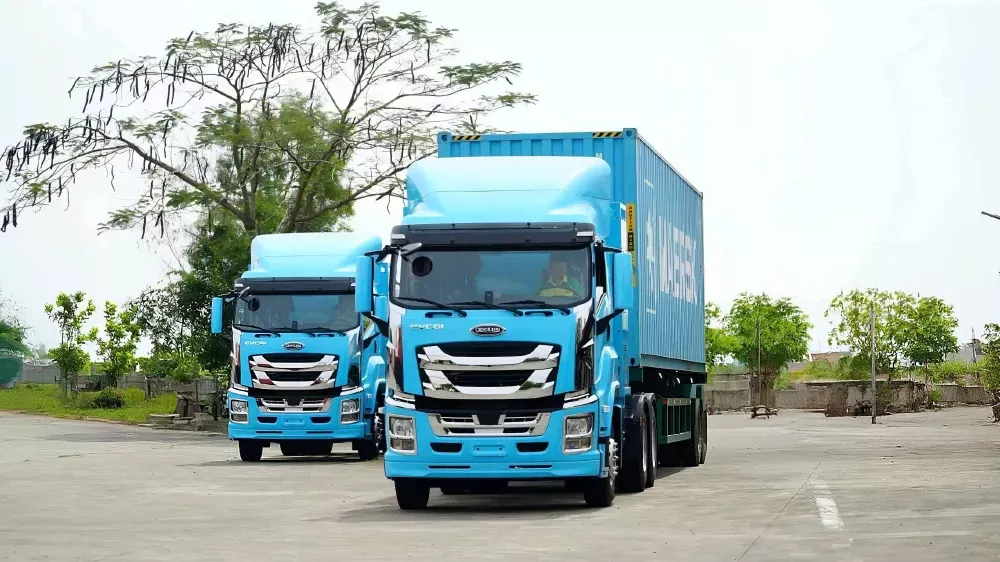
▲Qingling’s EVC61 exported to Vietnam. Photo provided by the company.
Success in the Mediterranean country market represents a crucial step on Qingling’s global chessboard.
“This country isn’t just a single market requiring tens of thousands of commercial vehicles annually; it’s the ‘crossroads’ of three continents: Europe, Asia, and Africa,” Zhang Yuan drew a circle on the office map. “Its influence radiates through a developed logistics network to the Middle East, North Africa, Southern Europe, and beyond.”
The country’s commercial vehicle and chassis market structure is unique: the bus chassis market is held by European and American brands, while the majority of light trucks and pickups are controlled by North American brands with outdated technology and lower emission standards.
Facing this “vacuum zone” for “Made in China,” Qingling did not opt for a blanket low-price strategy but instead implemented a precise “customization strategy.”
The Qingling team keenly identified a strong local demand for high-performance small trucks. “Local residents love buying pickups, with annual sales reaching tens of thousands of units,” Zhang Yuan said.
Consequently, Qingling completely transformed its base pickup truck model sold domestically: it switched from two-wheel drive to four-wheel drive for desert conditions and added a full tipper cargo box based on local construction and agricultural needs.
“This doubled the pickup’s practicality,” Zhang Yuan explained. This original development significantly increased the final selling price of Qingling pickups locally, with profits far exceeding those in China. From initial contact in March 2025 to mass orders in October of the same year, Qingling took just over six months to complete product certification and deliver thousands of pickups in batches.
More profound impacts are unfolding. It is reported that, impressed by the company’s products, local clients have begun negotiations with Qingling on electric vehicle projects. In the future, Qingling hopes to launch a model integrating “Chinese technology + localized manufacturing + global supply chain integration” along the Mediterranean coast.
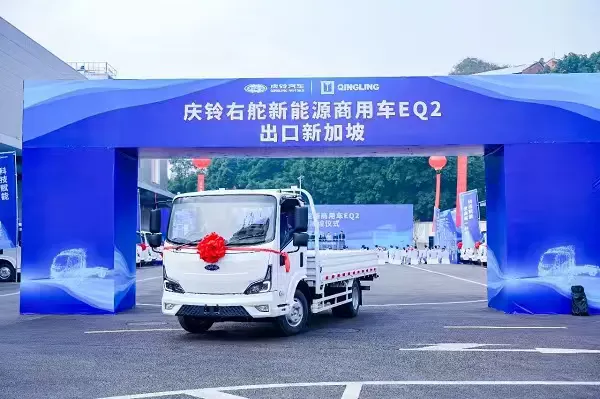
▲ The EQ right-hand drive light truck is one of the landmark achievements of the China-Singapore (Chongqing) Strategic Connectivity Demonstration Project. Photo provided by the company.
Why did Qingling choose to initiate its global expansion model in the Mediterranean?
“Times and trends!” Zhang Yuan told reporters. Since its inception in 1985 as “China’s first Sino-Japanese joint venture automaker,” Qingling has built a complete high-end commercial vehicle industrial chain and developed thriving business. However, with global industrial transformation, Qingling realized that the simple product trade model had hit its “ceiling.” Without moving from domestic to overseas markets, upgrading from “selling products” to “selling an ecosystem,” the company would face significant development bottlenecks.
To this end, Qingling recently established the “1093 Pilot” plan, aiming to establish nine KD (knocked-down) assembly plants in the ten countries with the highest commercial vehicle export volumes, pushing export scale beyond 30,000 vehicles.
This is no longer simple “assembly,” but a comprehensive capacity-building effort encompassing rapid certification and market entry, full-process information-based shipping, and localized talent cultivation.
The Mediterranean presence is a critical move in implementing this plan.
Furthermore, within Qingling’s strategic framework, 2026 will see a pivotal development: the establishment of a new joint venture with Isuzu in the new energy sector. At that time, Qingling will be responsible for core technology R&D and manufacturing, while Isuzu will open its global channels to help distribute its products.
Today, besides the Mediterranean coast, Qingling’s overseas strategy is flourishing across multiple fronts:
In Zambian copper mines, Qingling uses modified four-wheel-drive vehicles to carve out a niche in extreme road conditions. On the freezing wastelands of Central Asia, hydrogen-powered heavy trucks demonstrate their cold-weather resilience. In Singapore, right-hand drive new energy commercial vehicles have been delivered in batches. In Vietnam, Maersk is adopting Qingling’s systematic battery-swapping heavy truck solutions… Each strategic move collectively shapes Qingling’s path to global markets.
“‘Chongqing-Made’ ventures across the globe, relying on that unyielding spirit of perseverance,” Zhang Yuan gazed out the window. Beside the factory, hundreds of vehicles, soon to bear overseas labels, stood ready for departure.
Source: New Chongqing – Chongqing Daily
Disclaimer: Unless otherwise stated for original content, articles and images are sourced from the internet and major mainstream media. Copyright belongs to the original authors. Please contact us for removal if infringement is suspected.